
The Right Screen-Cleaning Setup for WFH Desks: Spray, Microfiber Cloth or Cleaning Kit?
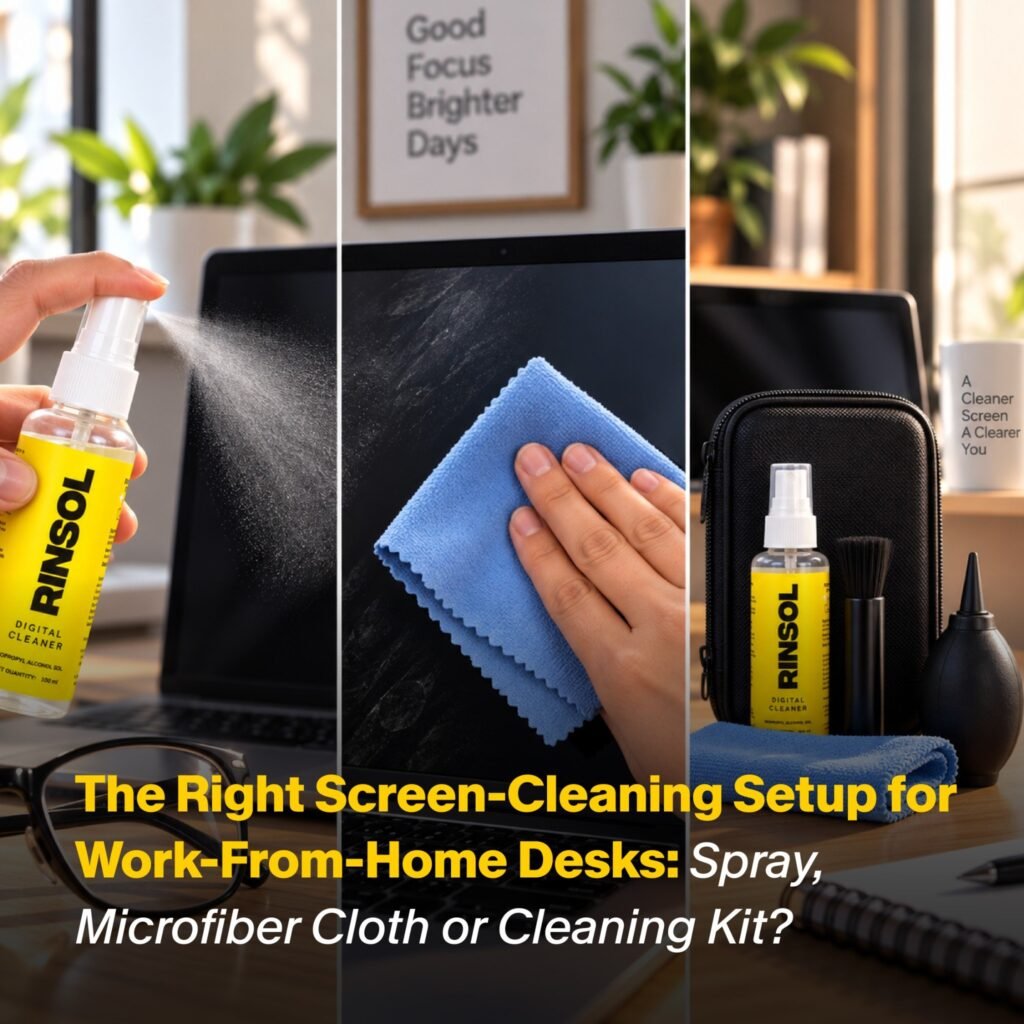
Screen Care Guide 2026 Gaymed Labs Research Team•Updated 2026•6 min read Quick Answer For most work-from-home desks, a dedicated screen cleaner spray plus a clean, dedicated microfiber cloth is the complete answer. Spray onto the cloth (never the screen), wipe with light straight strokes, and keep the screen powered off. If you also want to maintain your keyboard and ports, a laptop cleaning kit bundles everything in one organised set. Avoid glass cleaner, tissues and ordinary cloths. Why Screens Get Dirty Compare Options What to Avoid How Often Rinsol FAQ Working from home means your laptop or monitor is on for 8 to 12 hours a day, every day. It sits on a desk where you eat lunch, drink coffee, rest your hands and occasionally sneeze. It gets touched, adjusted and peered at closely whenever something on screen is not quite visible. Over time, a screen that came out of the box with perfect clarity develops a persistent haze of fingerprints, dust and skin oils that no amount of squinting improves. Most work-from-home setups have no dedicated screen cleaning solution at all. People reach for a tissue, a glasses cloth found in a drawer, or a spritz of whatever spray is on the desk. All of these are either ineffective or actively damaging. Setting up the right solution is a small investment that protects a much larger one. 1Why Do Laptop and Monitor Screens Get Dirty So Quickly? The specific contamination sources of a home desk A screen at a work-from-home desk accumulates contamination from several sources that an office screen might avoid. Fingerprints & Touch Contact The most visible source. Even non-touchscreen displays get touched more than people realise: adjusting the hinge, pointing at something on screen, rubbing off a smudge that turns into three more. Each contact deposits skin oils that attract and hold dust. Effect: Oily smudges that grab dust. Airborne Dust & Cooking Particles Home desks are often near cooking areas, windows open to dustier outdoor air and general household dust. Offices tend to have more controlled air and regular cleaning. At home, your screen collects whatever is in the air around it all day. Effect: A steady film that builds through the day. Breath & Sneezing Not something anyone likes to consider, but relevant at home where there is no office distance. Close work at a desk means the screen receives direct breath exposure throughout the day. Effect: Moisture and droplets that leave spots. Keyboard Rebound Dust settled beneath the keys is sent upward toward the screen each time keys are pressed. Over a full day of typing, this adds meaningfully to the particle load on the display surface. Effect: Extra dust landing right where you look. WFH Screen Cleaning Options Compared Select an option to see where it works and where it falls short Screen Cleaner Spray Microfiber Cloth Cleaning Kit Where It Works ✓Formulated for electronic display surfaces ✓Mild surfactants lift oils and fingerprints without affecting anti-reflective, anti-glare or oleophobic coatings ✓The most economical and thorough option for regular cleaning Limitation ✕Needs a clean microfiber cloth to work ✕Must go onto the cloth, never directly onto the screen ✕Does not address keyboard debris Expert note: Proper screen cleaner chemistry is completely different from household glass cleaner. Ammonia, common in window sprays, degrades screen coatings with repeated use. Two to three sprays on the cloth is enough for a standard laptop or monitor. Where It Works ✓The only appropriate wiping material for display surfaces ✓Split-fibre construction lifts and traps particles instead of pushing them across the screen ✓Ideal for dry dust removal between full cleans Limitation ✕Cannot remove oils without cleaning fluid ✕A cloth used on other surfaces, left loose on the desk or unwashed for several uses is no longer safe ✕Should be kept separate from glasses and kitchen cloths Expert note: Microfiber is safe for screens only when it is clean. Keep a dedicated screen cloth in a sealed pouch or case between uses. Where It Works ✓Bundles screen spray, microfiber cloths and typically swabs for keyboard gaps and ports ✓One organised solution instead of sourcing parts separately ✓Covers every component of a desk setup Limitation ✕Slightly higher initial cost Expert note: A spray alone does not address keyboard debris, and a cloth alone redistributes oils rather than removing them. A kit with the right combination addresses both. At a Glance Cleaning Option Best For Limitation Screen cleaner spray alone Regular light cleaning Needs a clean microfiber cloth to work Microfiber cloth alone Dry dust removal between full cleans Cannot remove oils without cleaning fluid Laptop cleaning kit Complete desk setup maintenance Slightly higher initial cost The Best Way to Clean a Laptop or Monitor Screen Takes About 2 Minutes 1 Power off and let the screen cool An illuminated screen hides dust and smudges, leading to incomplete cleaning. Heat also speeds up evaporation and reduces how well the cleaning fluid works. 2 Spray the cloth, not the screen Most Important Step Apply two to three sprays of dedicated screen cleaner to a clean microfiber cloth. Liquid applied directly to a screen runs toward the edges and can seep behind the bezel. 3 Wipe in light, straight strokes Work left to right in overlapping passes, using light pressure rather than circular scrubbing. Finish with a dry pass using a clean section of the cloth to check for streaks. What Should You Avoid When Cleaning Screens? Can you use glass cleaner on a laptop screen? No. It is one of the most common and consistently damaging screen cleaning mistakes. Here is what to keep away from your display. Household Glass Cleaner Contains ammonia, which cleans windows well but progressively degrades anti-reflective and anti-glare coatings. The damage is cumulative and invisible until the screen looks permanently hazy. Tissues & Paper Towels Tissues feel soft but are abrasive at a microscopic level because of wood fibre content. Fine scratches add up to permanent haze over weeks and months. Paper towels are even more abrasive.
Why Do Glasses Get Dirty So Quickly During Daily Commutes? Pollution, Dust and Sweat Explained
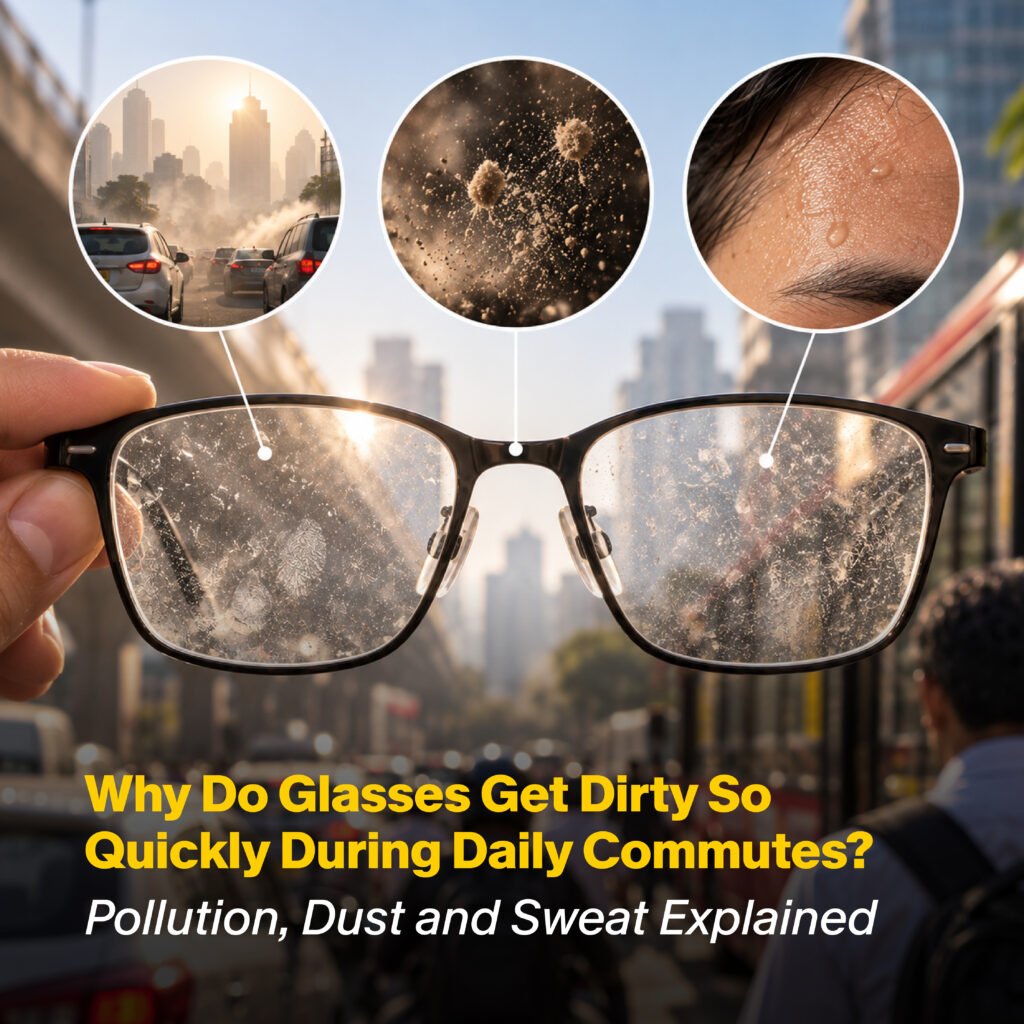
Daily Lens Care Guide 2026 Gaymed Labs Research Team• Updated 2026• 6 min read Quick Answer Your commute is one of the harshest places for your glasses. Airborne dust and pollution, sweat and skin oils, humidity and constant frame adjustments all land on your lenses at once, so they can go from clean to dirty in under 30 minutes. You are not doing anything wrong. What matters is how you clean them: remove loose dust first, use a dedicated glasses spray, and wipe with a clean microfiber cloth. Why They Get DirtyContamination MatrixPollution & Dust3-Step MethodWhat to AvoidDaily HabitsRinsolFAQ You clean your glasses before leaving home. By the time you reach your office, workplace or destination, they are already smudged, dusty and noticeably less clear than when you started. If this happens every single day, you are not imagining it, and you are not doing something wrong. The daily commute in any Indian city is genuinely one of the harshest environments your glasses will encounter. Pollution, dust, sweat, humidity and repeated frame adjustments combine to create a level of lens contamination far beyond what your glasses face at a desk or at home. Understanding what is happening to your lenses helps you clean them correctly when you arrive and protect them better along the way. 1Why Do Glasses Get Dirty During Daily Commutes? Why do my glasses get dirty so quickly? A commute combines several contamination sources at the same time. Each one would produce noticeable smudging on its own. Together, they can take lenses from clean to significantly dirty in under 30 minutes. Airborne Dust & Pollution The most constant source. Urban air carries particulate matter, vehicle exhaust, construction dust and general debris. These particles stay suspended and settle continuously on any exposed surface, including your lenses. Effect: A steady layer of fine particles builds up the whole way to work. Sweat & Skin Oils Movement, warm weather and the stress of traffic all raise perspiration. Sweat from the forehead and nose bridge transfers to the frame and then to the lens, and mixes with skin oils into a tenacious smudge. Effect: Harder to remove than dry dust alone. Humidity & Moisture During monsoon or humid conditions, a thin moisture film forms on the lens. It attracts and holds airborne particles more readily than a dry surface does. Effect: Lenses that repel dust when dry collect it far more aggressively when damp. Frequent Frame Adjustments In crowded transport, with bags and obstacles, you adjust your glasses far more than when stationary. Each touch transfers fingertip oils and whatever your hands have handled. Effect: A habit most wearers never consciously notice. Commute Contamination Matrix Select a contamination source to see what it does and how to respond Dust & PollutionSweat & Skin OilsHumidity & Moisture What Goes Wrong Fine particles settle on the lens all journey long Wiping with a tissue, sleeve, dupatta or shirt hem Particles become abrasive under wiping pressure Safer Response Blow gently across both sides of the lens first Or rinse briefly under lukewarm water Then spray and wipe with clean microfiber Expert note: The damage from dust is physical and indirect. It comes from the wiping response, not from the dust sitting on the lens. What Goes Wrong Sweat transfers from forehead and nose bridge Fingertip oils added with every adjustment Hand sanitiser used as a quick fix Safer Response Use a pH-balanced glasses spray with mild surfactants Buff with a clean microfiber cloth Hold glasses by the temples, not the lenses Expert note: Sweat and oil together make a smudge that needs a proper cleaning solution. Dry wiping only spreads it. What Goes Wrong Thin moisture film holds particles on the lens Dust collects faster than in dry conditions Wet wipes not made for optical surfaces leave residue Safer Response Rinse loose particles under lukewarm water Use a coating-safe spray or wipe Store glasses in a hard case when off your face Expert note: Moist lenses behave very differently from dry ones. Clear the particles first, then clean. 2Can Pollution and Dust Affect Your Glasses? Can pollution damage spectacle lenses directly? Airborne pollution does not chemically damage lens coatings the way ammonia-based cleaners do. The damage from pollution and dust is physical and indirect. Fine particles on a lens are abrasive at a microscopic level. A dusty lens that is rinsed and wiped properly carries minimal scratch risk. The problem is the wiping response most commuters use: a tissue, a sleeve, the corner of a dupatta or a shirt hem. Every particle on the lens becomes an abrasive the moment it is caught between the lens and a wiping material under pressure. The long-term cost: Each scratch is microscopic and invisible on its own. After months of daily commutes with this habit, the cumulative micro-scratching produces a visible, permanent haze that no cleaning can reverse. How pollution particles reduce lens clarity Beyond scratch risk, a film of urban pollution reduces clarity in its own right. Vehicle exhaust and industrial pollution carry carbon compounds and fine metallic particles that form a visible grey-brown film when present in sufficient concentration. This film scatters and absorbs light, lowering the contrast and clarity of your vision even before any wiping has caused scratches. That is why lenses feel noticeably clearer after a thorough clean following a commute, and not just cleaner in appearance. The Best Way to Clean Glasses After a Commute Takes About 2 Minutes The key difference between cleaning dusty commute lenses and lenses with only fingerprints is the preparation step. With dusty lenses, skipping preparation causes the most damage. 1 Remove dust and loose particles before wiping Most Important Step Never wipe a dusty lens directly with any cloth, even a clean microfiber one. Blow gently on both sides of the lens to dislodge surface dust. If running water is available, a brief rinse under lukewarm water is even more effective. This turns a risky job, dragging abrasive particles across a coated surface, into
AI Glasses, Blue-Light Glasses and Anti-Glare Lenses: Can You Clean Them the Same Way?
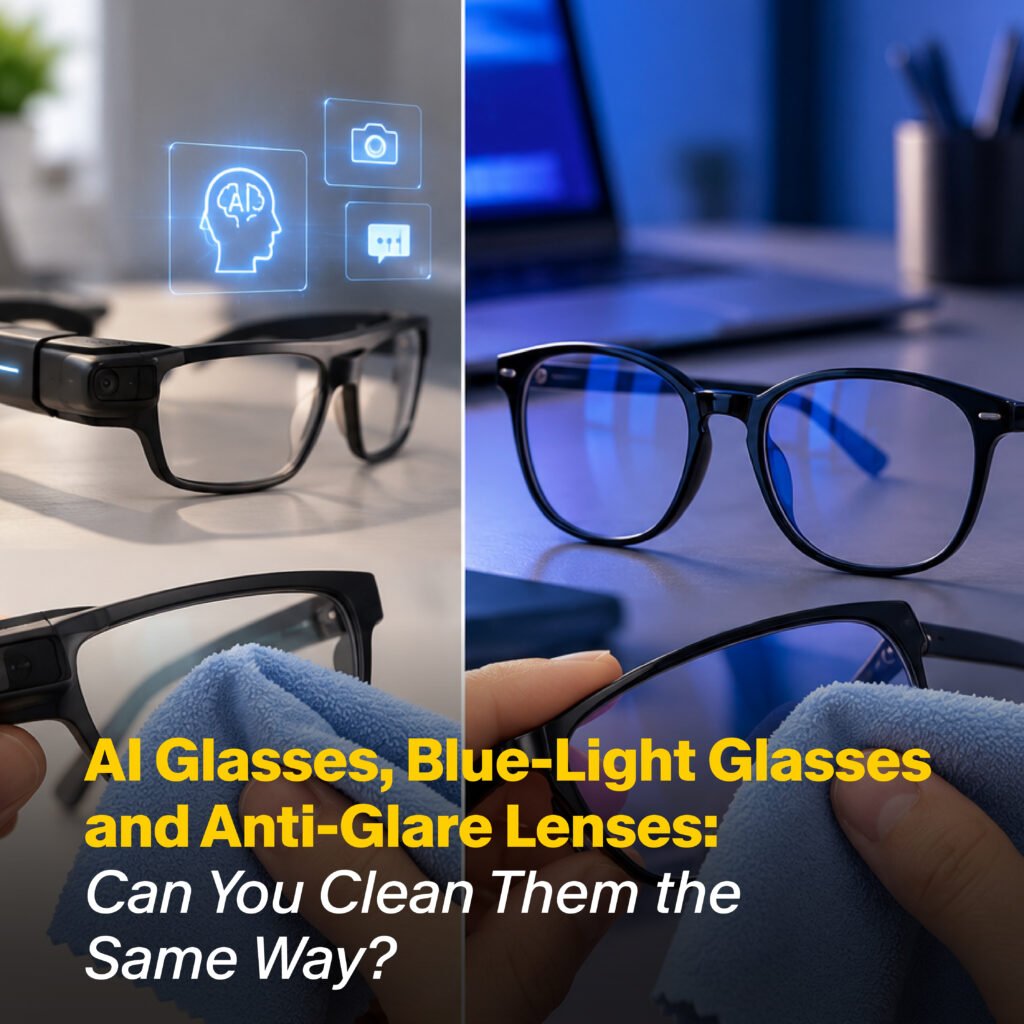
Optical Care & Smart Eyewear Guide 2026 Gaymed Labs Research Team• Updated 2026• 6 min read Quick Answer No, they need different care. Plain uncoated glasses tolerate basic wipes, but blue-light and anti-glare (AR) coatings are thin surface layers that can be damaged by ammonia and strong alcohol-based cleaners. AI smart glasses need the same lens care plus strict moisture control around microphones, sensors and charging pins. Coatings Care Matrix 5-Step Method Chemical Hazards AI Glasses Rules Rinsol FAQ The glasses on your face in 2026 are a different kind of technology from the glasses your parents wore. Blue-light filtering lenses are common for anyone who spends long hours on screens. Anti-glare coatings are now a baseline rather than a premium upgrade. And AI glasses, frames with cameras, microphones, speakers and wireless connectivity built in, are moving from novelty to mainstream faster than most people realise. What hasn’t kept pace is how people clean them. Most wearers still reach for a shirt hem, a tissue or whatever glass cleaner is nearby. On plain uncoated lenses that causes scratches over time. On modern coated lenses and electronic eyewear it can cause damage that is difficult or impossible to reverse. 1Do AI, Blue-Light & Anti-Glare Lenses Need Special Care? The Coating Complexity of Modern Lenses Modern spectacle lenses are not a single material with a single surface. They are a base lens with typically three to seven functional layers applied on top, each with its own purpose and its own chemical sensitivity. Lens Coating Stack (Illustrative Microscopic View) Layer 5: Hydrophobic & Oleophobic Top CoatRepels Water & Oils Layer 4: UV Blocking TreatmentBlocks UV Radiation Layer 3: Blue-Light Filtering LayerReflects/Absorbs HEV Light Layer 2: Anti-Reflective (AR) CoatingReduces Glare & Reflections Layer 1: Hard Scratch-Resistant CoatBase Protection Base Optical Polymer / Glass Core These coatings are designed on the assumption that lenses will be cleaned with appropriate optical products. They are not designed for hand sanitiser, window cleaner, kitchen spray, or the dry friction of a polyester shirt. Blue-Light Lenses Blue-light filtering works by absorbing or reflecting specific wavelengths of high-energy visible (HEV) light. If harsh cleaners degrade the coating, the lens can look perfectly clear while filtering less than it should. Safe practice: Clean with a pH-balanced solution made for optical surfaces. Anti-Glare (AR) Lenses AR coatings use thin-film interference to cancel reflected light, which depends on very uniform thickness. Because they cut reflections, AR lenses also show fingerprints, streaks and chemical marks more clearly than plain lenses. Safe practice: Avoid ammonia-based glass cleaners, which can cause micro-cracking (crazing). Eyewear Care Compatibility Matrix Select your eyewear type to see safer vs risky methods Standard Optical Lenses Blue-Light / AR Lenses AI Smart Glasses Safer Methods Dedicated pH-balanced optical spray Clean microfiber cloth Warm water and a drop of mild soap, then dry Risky Methods Dry paper tissues or paper towels Shirt hems and rough fabrics Wiping dusty lenses without blowing off grit first Expert note: Fairly durable, but dry or abrasive wiping causes fine scratches over time. Safer Methods Ammonia-free optical lens sprays Light circular microfiber wipes A consistent daily routine Risky Methods Window or glass cleaner (ammonia) Strong rubbing alcohol Hand sanitiser Expert note: Coatings are sensitive. Harsh cleaners can wear down filtering and top coats without obvious visible change. Safer Methods Spray on the cloth only, never the frame Dry microfiber around microphones Dry cotton swab for camera edges Risky Methods Spraying directly onto frame or hinges Submerging or rinsing the frames Damp wipes over charging contacts Expert note: Dual risk: lens coatings can be damaged, and liquid getting inside can damage the electronics. The Universal 5-Step Cleaning Method Suitable for Daily Use 1 Remove loose particles first Blow gently across both sides of the lens to dislodge dust and grit that could scratch during wiping. On AI glasses, avoid blowing moist breath into camera or microphone openings. A soft brush or air bulb is ideal if you have one. 2 Apply the cleaner to the cloth, not the glasses Important for AI Glasses Spray 2–3 light spritzes of optical cleaner onto a clean microfiber cloth. Never spray liquid directly onto smart frame hinges, microphone grilles or charging pins. 3 Wipe with light pressure Wipe each lens in gentle circular motions from the centre outward, using light, even pressure. Don’t rub hard over sensor openings. 4 Finish with a dry pass Switch to a dry, clean section of the cloth and buff lightly. Hold the lenses up to a light source to check for streaks or smudges. 5 Care for frame and nose pads Lightly wipe nose pads and arms to remove facial oils. On AI glasses, keep damp cloths away from charging terminals and audio ports. How Harsh Cleaners Can Damage Modern Lenses Ammonia (Window Cleaners) Can attack AR coatings and cause crazing, a spiderweb pattern of fine cracks that cannot be reversed. Strong Rubbing Alcohol Repeated use can wear down hydrophobic and oleophobic top coats, leaving lenses that smudge easily and feel sticky. Shirt Hems & Paper Tissues Wood-pulp fibres and synthetic weaves are abrasive at a microscopic level and can leave fine scratches over time. Bleach & Hand Sanitiser Harsh chemicals can degrade lens coatings and may weaken frame seals, which is a particular concern for electronic eyewear. AI Smart Glasses: Protecting the Electronics Cameras, microphones, speakers and charging contacts AI glasses need everything coated spectacle lenses need, plus protection for the embedded hardware. A thorough daily lens clean using the cloth-first spray method is the safe approach. Between full cleans, use a dry microfiber cloth to remove dust without bringing moisture near small openings. Camera Lenses Clean with ultra-soft dry microfiber only. Use a dry cotton swab for edges. Mic & Speaker Ports Never spray liquid at the grilles. Moisture can damage mesh and internal parts. Charging Pins Make sure contacts are fully dry before placing the frames in the charging case. Formulated by Gaymed Labs (GLPL) Rinsol Lens Cleaner: Made for Coated & Smart
Do Anti-Fog Sprays Really Work on Glasses? What Wearers Should Know
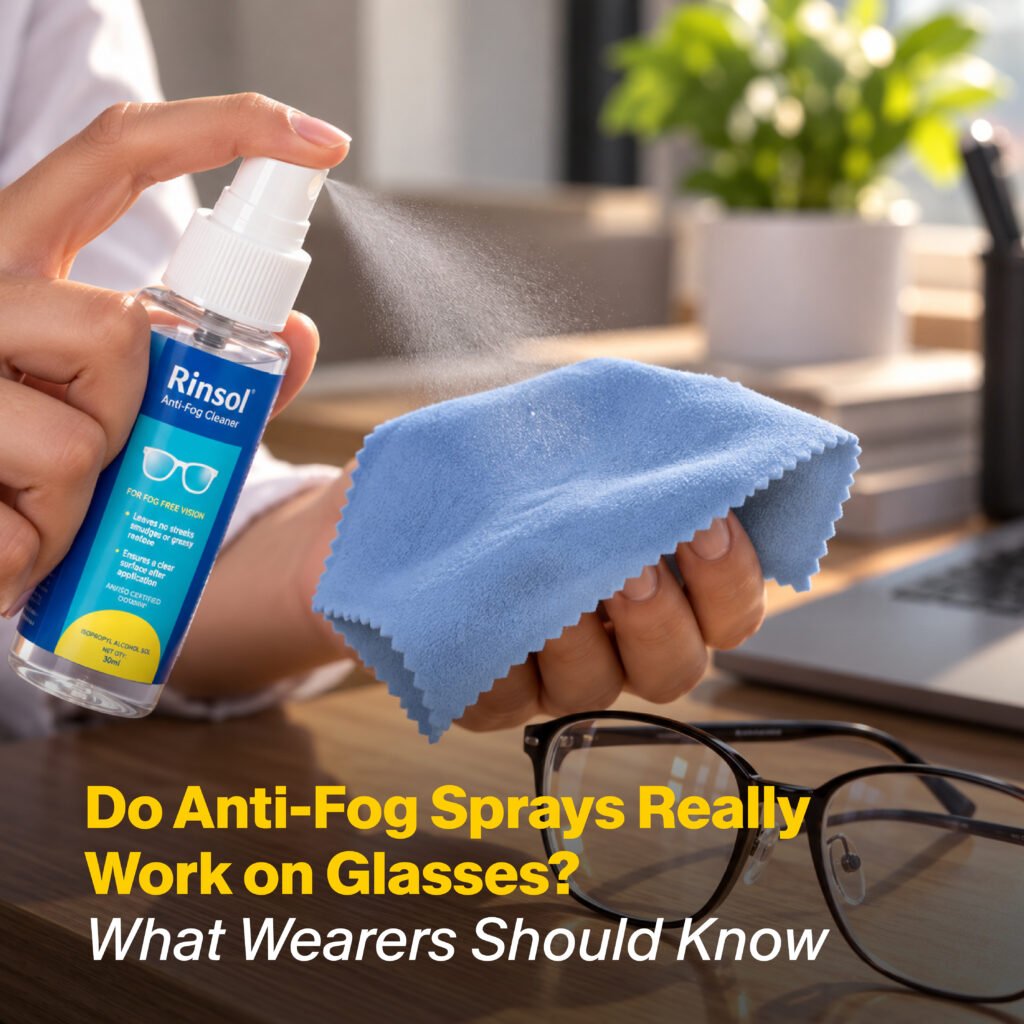
Introduction If you wear glasses, you have experienced the frustration of fogging at least once today. Walking out of an air-conditioned mall into warm outdoor air. Pulling a mask up over your nose. Leaning over a pot on the stove. Finishing a brisk walk and stepping into a cooler room. Each of these ordinary moments produces the same result. Your lenses go white and your world disappears for several seconds. Anti-fog sprays promise to solve this. But do they actually work, or are they just another product that underdelivers on its claim? The honest answer is that they genuinely work, but with important qualifications about application, maintenance, and realistic expectations that most product descriptions do not clearly explain. Why Do Glasses Fog Up? The physics behind fogging Fogging is condensation, and condensation follows a simple physical rule. When warm, moisture-laden air meets a surface that is cooler than the dew point of that air, water vapour converts from gas to liquid on that surface. Your spectacle lenses become that cool surface whenever they are at a lower temperature than the surrounding air. This happens predictably in several everyday situations. Moving from a cool air-conditioned interior to warm outdoor air. Wearing a face mask that directs warm exhaled breath upward toward the lower portion of your lenses. Transitioning from cold outdoor air into a heated room. Exercising when your body heat elevates the temperature and humidity of the air immediately around your face. The lenses fog because thousands of microscopic water droplets form on their surface simultaneously. These droplets scatter light in every direction rather than allowing it to pass through cleanly, creating the opaque white visual disruption that makes seeing impossible until the lenses warm to ambient temperature and the droplets evaporate. Why some wearers fog more than others Individual fogging severity depends on the temperature differential between the lens and the ambient air, the humidity of that air, and how quickly the lens equilibrates to the new temperature. Thicker lenses with more thermal mass take longer to warm and therefore fog more persistently. Lenses with certain anti-reflective coating types may also show fogging more visibly than untreated lenses. How Does Anti-Fog Spray Work? The surface chemistry explanation Do anti-fog sprays really work on glasses? Yes, and the mechanism is well-established surface chemistry. Standard lens surfaces have a characteristic that causes water to bead into discrete droplets when it contacts them. These beaded droplets are what scatter light and create the fogging effect. An anti-fog spray deposits a hydrophilic layer onto the lens surface. Hydrophilic means water-attracting. On a hydrophilic surface, incoming moisture does not bead into droplets. Instead, it spreads into an extremely thin, uniform film across the surface. This film is optically transparent because it is even enough not to scatter light the way beaded droplets do. The moisture is still there, but it is spread so thinly and uniformly that it does not interrupt your vision. This is the fundamental difference between an untreated lens that fogs opaquely and a treated lens that may experience a slight, brief haziness during an extreme temperature transition but clears within seconds rather than blocking vision for fifteen to thirty seconds. Why the Right Product Matters for Coated Lenses Not all anti-fog products are formulated with spectacle lens coatings in mind. Products designed for automotive windscreens, bathroom mirrors, or general glass surfaces may contain compounds that are effective on uncoated glass but aggressive toward the anti-reflective, hydrophobic, UV, or blue-light coatings on your spectacle lenses. A proper anti-fog spray for glasses is pH-balanced, free of ammonia and harsh solvents, and specifically formulated to be safe for optical coating chemistry. Using an automotive anti-fog product on anti-reflective coated lenses risks degrading the coating over repeated use, creating a permanent haziness that the fogging you were trying to prevent would never have caused. How Should You Apply Anti-Fog Spray to Glasses? Improper application is the most common reason anti-fog products underperform or cause problems. The spray itself, when properly formulated, does not damage coatings. But incorrect application technique produces either insufficient protection, visible streaking, or a blurry film that is ironically worse than the fogging it was meant to prevent. Step One: Clean Your Lenses First This is the step that determines whether everything else works. The anti-fog compounds need to bond directly to the lens surface. If fingerprints, skin oils, makeup residue, or dust are present on the lens before application, the anti-fog layer bonds to that contamination layer instead of the lens. The protection it provides is weak, uneven, and short-lived. Clean your lenses thoroughly with a dedicated glasses cleaner spray and a clean microfiber cloth before applying any anti-fog product. Allow the lenses to dry completely. Starting with a genuinely clean, dry lens surface is what makes the difference between anti-fog treatment that lasts one to three days and treatment that wears off within an hour. Step Two: Apply One to Two Sprays Per Lens Side Apply a small, even amount of anti-fog spray to both sides of each lens. One to two sprays per side is sufficient. This is where more is definitively not better. Excess product creates a thick, uneven film that does not spread into the transparent layer the treatment is designed to produce. Instead of invisible protection, you get a blurry, streaky coating that obscures vision rather than preserving it. Use the minimum amount that covers the lens surface evenly. Step Three: Buff with a Clean Microfiber Cloth Using a clean, dry microfiber cloth for glasses, buff both sides of each lens with light, straight strokes until the surface is completely clear. There should be no visible wet patches, streaks, or haze remaining after buffing. The buffing step spreads the anti-fog compounds into a uniform, thin layer across the entire lens surface and removes the carrier liquid in which those compounds were suspended. What remains is the hydrophilic treatment itself, invisible and ready to function. Step Four: Allow Two Minutes to Set Do not put
Why Do Glasses Get Smudged During Festivals? Makeup, Sweat and Pollution Explained
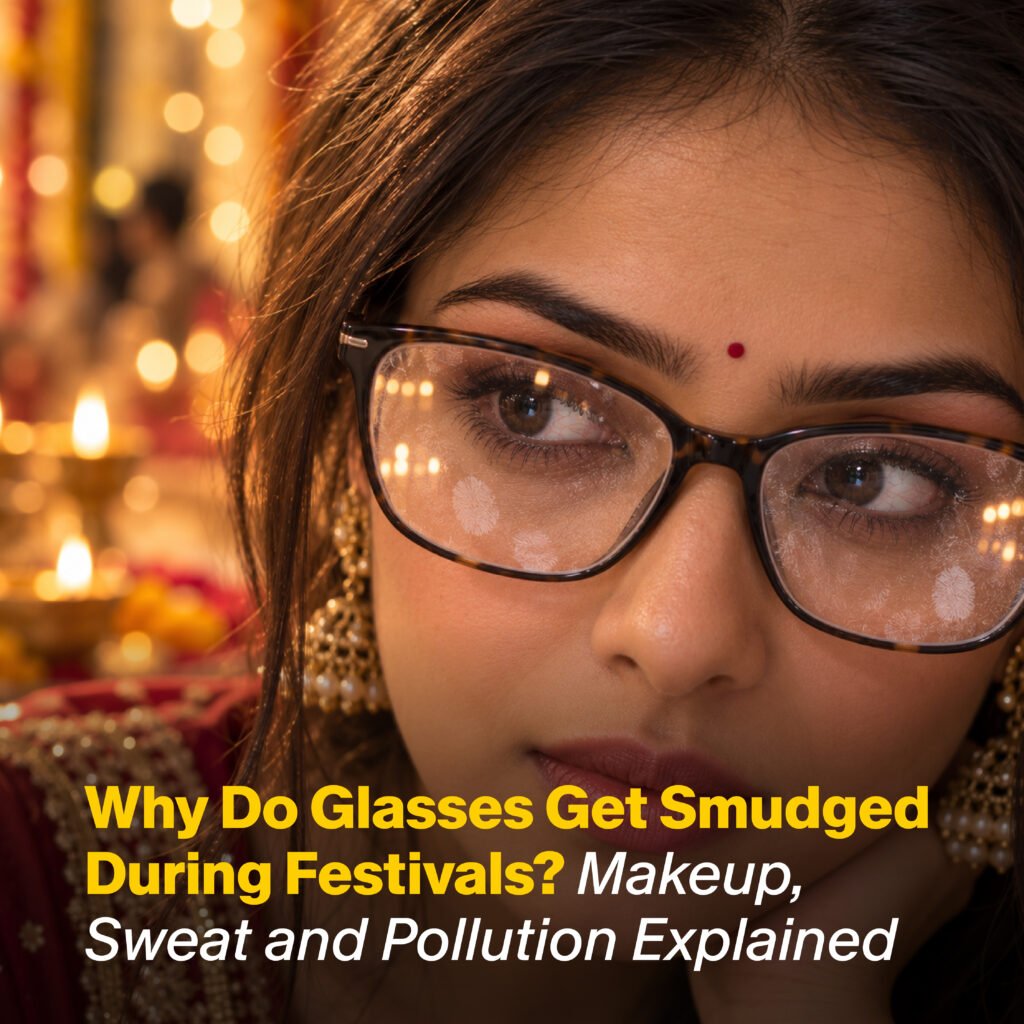
Introduction Festival season is wonderful for everything except your glasses. Between the foundation that transfers from your nose bridge, the kajal that somehow migrates upward, the sweat from hours of dancing, the smoke from diyas and fireworks, and the repeated adjustments you make to your frames throughout the day, your lenses take an extraordinary amount of abuse in a very short time. By mid-event, what started as perfectly clear lenses have turned into a smudged, hazy surface that you are constantly trying to wipe clean with whatever is nearest. Which, unfortunately, usually makes things worse. Understanding why festival conditions are particularly hard on glasses lenses helps you manage the problem properly rather than creating new problems while trying to solve the existing one. Why Do Glasses Get Smudged So Easily? Why do my glasses get smudged so quickly during events? Under normal daily conditions, the primary sources of lens smudging are skin oils from your nose bridge and fingerprints from adjusting the frames. During festivals, you add several additional contamination sources simultaneously. Makeup Transfer is one of the most significant contributors. Foundation, BB cream, and face primer applied to the nose and cheeks make direct contact with the nose pads and the section of the frame that rests against your face. From there, these products transfer to the frame and eventually to the lens edge and surface. Heavy eye makeup including kajal, eyeshadow pigment, and mascara particles migrate throughout the day. Sweat accelerates this migration by providing a liquid medium through which cosmetic products travel from the skin surface to the lens. Sweat and Humidity during dancing, outdoor events, and the general warmth of festive gatherings create a thin film of moisture on the skin that carries skin oils, makeup, and environmental particles toward the lens surface. In humid conditions, this film accumulates faster and transfers more readily to the lens than in dry conditions. Pollution and Fireworks Particles settle on lens surfaces continuously during outdoor exposure. Fine particulate matter from fireworks smoke, dust from outdoor venues, and general urban pollution all add to the smudge load on lenses during festival periods. Frequent Handling is the factor that compounds all of the above. Every time you push your glasses up your nose, adjust the temples, or remove and reinsert them, you transfer whatever is on your fingertips to the frame and lens. During a long festival event, this happens dozens of times. Can Makeup and Sweat Damage Your Glass Lenses? Makeup itself does not directly damage lens coatings in the way that harsh chemicals do. The damage comes from what people do when trying to remove makeup from their lenses, and from the repeated friction of wiping that occurs when lenses get smudged repeatedly throughout an event. When lenses are smudged with a combination of foundation, kajal, and sweat, the natural response is to grab the nearest material and wipe. During a festival, this usually means a dupatta, a tissue, a paper napkin from the catering table, or a regular cloth. Each of these materials is abrasive at a microscopic level. The fine scratches they create are individually invisible but collectively produce the haze that develops on lenses over months of incorrect cleaning. Sweat presents a specific chemical concern for lens coatings. Human sweat is slightly acidic, with a pH typically between 4.5 and 7.5. Repeated contact of sweat with anti-reflective coatings, particularly when followed by wiping before the sweat has been rinsed away, creates a mild chemical exposure that compounds over time. Anti-reflective coatings that are repeatedly exposed to sweat and then wiped with abrasive materials degrade faster than those maintained with proper cleaning. Why the Right Cleaning Method Matters Even More at Events The importance of using proper cleaning tools and products becomes even more pronounced during festival conditions because the smudging is more frequent, the contamination is more varied, and the temptation to reach for whatever is nearby is at its highest. Each incorrect wipe during an event is a scratch. Each scratch accumulates toward permanent coating damage that cannot be reversed. What Is the Best Way to Clean Smudged Glasses? The correct method is the same as it is at home, applied with the right tools that you need to carry with you. Step One: Remove Loose Particles Before Wiping Before any cloth contacts your lens, remove loose particles by gently blowing on both sides of the lens. During festival conditions where dust, fireworks particles, and makeup residue are present, this step is especially important. Wiping a lens that has fine particles sitting on it drags those particles across the coating surface under pressure. If water is available and you are near a clean sink, a brief rinse under lukewarm water before wiping is even better for removing loose abrasive particles. Step Two: Apply a Proper Glasses Cleaning Spray Apply two to three sprays of a dedicated glasses cleaner spray to both sides of the lens. A proper glasses cleaning spray is pH-balanced and formulated to be safe for anti-reflective, UV, and blue-light coatings. It contains mild surfactants that lift makeup residue, skin oils, and sweat from the lens surface without interacting chemically with the coatings beneath. This is where the cleaning method matters most. Household products that might be nearby at a festival venue such as hand sanitiser, wet wipes, multi-surface sprays, or perfume should never be used on spectacle lenses. Hand sanitiser contains high-concentration alcohol that strips hydrophobic and anti-reflective coatings. Multi-surface sprays often contain ammonia. Even wet wipes not designed for optical surfaces can leave residue and cause coating damage. Step Three: Wipe with a Clean Microfiber Cloth Use a clean microfiber cloth for glasses to buff the lens gently in circular motions from the centre outward. The surfactants in the glasses cleaning spray have already loosened the smudge. The cloth’s job is to lift it away without scratching. The emphasis on clean is important. A microfiber cloth that has been loose in your bag throughout the event has picked up particles,
Why Do Your Eyes Feel Dry After a Full Day of Screens, AC and Contact Lenses?
Introduction You start the morning with comfortable lenses and clear vision. By mid-afternoon, your eyes feel gritty, heavy, and dry in a way that gets progressively worse with every hour you sit in front of your screen. By evening, you are blinking rapidly trying to generate some moisture, and the moment you take your lenses out, there is a relief so immediate that it tells you something has been wrong for hours. This experience is increasingly common, and it is not a coincidence that it clusters around the combination of screen use, air conditioning, and contact lens wear. Each of these factors affects the eye independently. Together, they create a compounding effect on tear film stability that makes dryness and discomfort almost inevitable without the right habits in place. Why Do Screens and AC Make Your Eyes Feel Dry? Why do my eyes feel dry after using screens? The answer begins with blinking. A healthy blink rate is approximately 15 to 20 blinks per minute. During screen use, this drops to as few as 5 to 7 blinks per minute, sometimes even less during intense focus on a task or content that holds attention strongly. Blinking is not just a reflex. It is the mechanism by which the tear film is renewed and distributed across the ocular surface. Each complete blink spreads a fresh layer of tears over the cornea, replenishing the lipid layer that prevents evaporation and clearing any debris from the surface. When blink rate halves, the tear film has twice as long to evaporate between renewals. The result is a progressively thinner, less stable tear film that leaves the corneal surface increasingly exposed. Does AC make contact lenses uncomfortable? Air conditioning significantly reduces ambient humidity by removing moisture from the air as part of the cooling process. In most Indian offices and homes running AC at typical summer settings, indoor relative humidity can drop to 30 to 40 percent, well below the 50 to 60 percent range that is comfortable for the ocular surface. In low-humidity air, tear film evaporation accelerates substantially. The tear film that takes a certain amount of time to evaporate in normal humidity evaporates significantly faster in the dry air of an air-conditioned room. For someone sitting still in front of a screen, blinking less frequently than they should be, in a room with AC running, this combination removes moisture from the ocular surface faster than the lacrimal system can replenish it. The Position Near AC Vents Matters If your desk, sofa, or sleeping position is directly in the airflow path from an AC unit or ceiling vent, the directed airflow across your face dramatically accelerates tear film evaporation. Moving out of direct airflow is one of the simplest and most immediately effective changes a dry-eye-prone contact lens wearer can make to their environment. Can Contact Lenses Make Screen-Related Dryness Worse? Can I wear contact lenses when my eyes are dry? You can, but a lens sitting on an already compromised tear film experiences and contributes to dryness differently than a lens on a healthy tear film. Contact lenses interact with the tear film by sitting within it. The tear film effectively splits into two layers when a lens is present, one in front of the lens and one behind it. The pre-lens tear film is thinner than the normal tear film and evaporates faster, particularly when blinking is reduced during screen use. The lens material itself also absorbs water from the surrounding tear film as part of maintaining its own hydration. This is particularly relevant for higher water content hydrogel lenses, which continuously draw moisture from the tear film to maintain their structural integrity. In conditions where the tear film is already thin due to reduced blinking and AC-driven evaporation, this additional demand on available moisture accelerates the drying of both the lens and the eye surface simultaneously. Dry eye symptoms to watch for during screen and AC exposure The progression of dry eye symptoms during a screen-heavy day in AC follows a recognisable pattern. Early signs include a subtle awareness of the lens that was not there in the morning. This progresses to a sandy or gritty feeling that worsens with each hour. By late afternoon, blurry vision that temporarily clears with blinking, redness, and a burning sensation are common. At this stage, the tear film is breaking down faster than it can be replenished. Recognising this progression early is important because acting at the early stage, taking a break, blinking deliberately, using appropriate lubricating drops, is far more effective than waiting until the burning and redness stage before doing anything. How Can You Keep Your Eyes Comfortable During the Day? How can I prevent dry eyes while wearing contacts during screen work? The most effective approach combines environmental adjustments, deliberate habit changes, and appropriate use of lubricating products. None of these require significant time or expense. The 20-20-20 Rule and Deliberate Blinking Every 20 minutes, look at something 20 feet away for 20 seconds. During this 20-second break, blink slowly and deliberately five to ten times. This combination gives your focusing muscles a brief rest and, more importantly for lens wearers, allows several complete blinks to renew the tear film and redistribute moisture across the lens surface. This single habit, applied consistently throughout the workday, meaningfully reduces the cumulative tear film deficit that produces severe end-of-day dryness. It requires no products and costs nothing. The difficulty is remembering to do it consistently, which is where phone reminders or dedicated apps can help establish the habit initially. Stay Hydrated Your tear production depends on your systemic hydration status. Mild dehydration, which many desk workers experience simply by not drinking enough water throughout the day, reduces tear volume. Keeping a water bottle at your desk and maintaining consistent fluid intake throughout the day is a genuinely useful intervention for dry eye symptoms, not just general wellness advice. Adjust Your Screen Position Looking down at a screen slightly, rather than straight ahead
Can Smoke, Fireworks and Air Pollution Affect Contact Lens Wearers?
Introduction Diwali, New Year celebrations, weddings with fireworks displays, and the general air quality that comes with Indian festive seasons create a unique set of challenges for contact lens wearers. The air during these periods carries significantly higher concentrations of smoke particles, chemical compounds from fireworks, and general pollution than any ordinary day. Your eyes notice the difference. Your contact lenses notice it even more. Understanding what is actually happening to your lenses and your eyes during high-pollution festive periods helps you take the right protective steps before symptoms develop rather than after your eyes are already burning. How Can Smoke and Pollution Affect Contact Lens Wearers? Does smoke make contact lenses uncomfortable? Yes, and the mechanism is direct. Airborne smoke particles are fine enough to remain suspended in the air for extended periods and small enough to penetrate through gaps around the edges of your lenses onto the lens surface itself. Once there, they sit between the lens and the tear film, causing physical irritation with every blink. Smoke also carries chemical compounds that dissolve into the tear film and alter its composition. This disrupts the lipid layer of the tear film, the outermost component responsible for preventing evaporation. When this layer is compromised, tear evaporation accelerates significantly, creating the dry, gritty feeling that lens wearers in polluted environments commonly experience. Can air pollution cause dry eyes while wearing contacts? Yes. Particulate matter in polluted air settles on the lens surface continuously during outdoor exposure. Unlike the natural tear proteins and lipids that deposit on lenses during normal wear, pollution particles are often chemically reactive. They interact with the lens material and the tear film in ways that compound dryness and irritation beyond what ordinary deposit accumulation produces. Contact lens wearers in high-pollution urban environments consistently report greater end-of-day dryness and discomfort than non-lens wearers in the same conditions. The lens surface acts as a collector for airborne particles, concentrating their effect on the ocular surface rather than allowing them to be distributed across the larger eye area. Why Festive Periods Are Particularly Challenging During Diwali and similar festivals, air quality in most Indian cities drops dramatically. Fireworks produce fine particulate matter, sulphur dioxide, nitrogen dioxide, and various metallic compounds from the chemical compositions that produce different colours. These are present in concentrations significantly higher than normal urban pollution levels. Lens wearers who are outdoors during these periods are exposing their lenses to a chemical and particulate environment that is more aggressive than what a standard daily cleaning routine is designed to handle. Can Fireworks Affect Your Contact Lenses? Can I wear contact lenses around fireworks? You can be present around fireworks while wearing contact lenses, but direct proximity to fireworks smoke and discharge should be avoided. The fine particles and chemical compounds produced by fireworks are among the more aggressive airborne contaminants for contact lens wearers, combining physical particulates with chemically reactive compounds in concentrations that exceed normal pollution exposure. What Fireworks Smoke Actually Contains The brilliant colours of fireworks come from metallic salts. Reds from strontium compounds. Greens from barium. Blues from copper. Whites from magnesium or aluminium. When these compounds combust, they produce fine particles of metal oxides and sulphates alongside smoke and carbon particles. In the air immediately around fireworks displays, these are present in high concentrations. When this mixture reaches your lens surface, which it will if you are within the smoke plume, you have chemically reactive metal compounds sitting on a surface that rests directly on your cornea. The irritation this causes is not the same as ordinary dust exposure. It is a chemical irritation layered on top of physical particle irritation. Protective Eyewear as a Practical Option For lens wearers who want to watch fireworks up close, wearing spectacles over contact lenses or switching to glasses entirely for the fireworks portion of the evening provides a physical barrier that meaningfully reduces particle and smoke exposure to the eye area. This is not overcaution. It is a practical step that protects both your eyes and your lenses. How Can You Protect Your Eyes While Wearing Contact Lenses? 1. Limit Direct Smoke Exposure Position yourself upwind from fireworks displays and bonfire-type celebrations where possible. Moving to a position where smoke is blowing away from rather than toward you significantly reduces the particle load reaching your lenses. Even a short repositioning makes a meaningful difference during extended outdoor events. 2. Keep the Lens Wear Period as Short as Practical On days with known high pollution or planned fireworks exposure, minimising total lens wear time reduces cumulative exposure. If your day allows it, wear glasses during the highest pollution periods, typically the evening hours of major fireworks events, and reserve lens wear for the portions of the day where air quality is better. 3. Use Fresh Multipurpose Contact Lens Solution After Any Smoke Exposure If you have been in a smoky or heavily polluted environment while wearing lenses, cleaning thoroughly with fresh contact lens cleaning solution when you return indoors removes the accumulated particles and chemical residue from the lens surface. Do not wait until bedtime if you experienced significant exposure. Clean as soon as practical after returning to a clean environment. 4. Blink Deliberately and Frequently During outdoor exposure to smoke and pollution, the natural response is to blink less due to irritation, which actually worsens the situation by slowing the natural flushing action of the tear film. Deliberately blinking fully and frequently helps distribute fresh tears across the lens surface and provides some mechanical flushing of surface particles. 5. Rinse Your Eyes If Necessary If significant irritation develops and you have lens-compatible sterile saline available, a gentle eye rinse after lens removal can help clear accumulated particles from the ocular surface. This is a support measure, not a replacement for removing the lens if it is causing discomfort. What Should You Do If Your Eyes Become Irritated? Should I remove my lenses if my eyes start burning? Yes, and without delay. Burning, stinging,
Wedding Season Contact Lens Care: How to Keep Your Lenses Comfortable From Day to Night
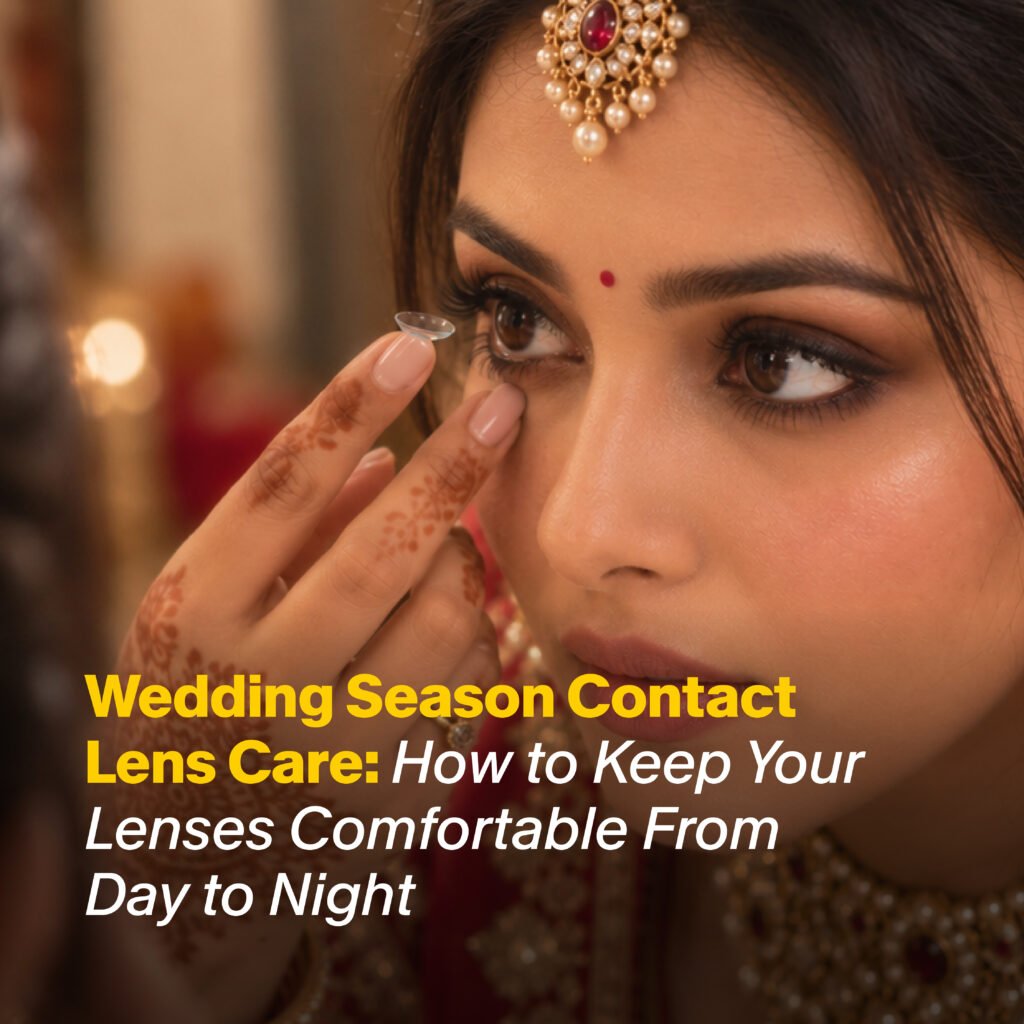
Introduction Wedding season in India is an experience unlike anything else. Mehendi ceremonies, sangeet nights, the main wedding, receptions that stretch well past midnight. Each event involves elaborate outfits, dramatic makeup, air-conditioned banquet halls, outdoor mandaps under warm lighting, and hours of dancing, photographing, and celebrating. For contact lens wearers, this combination creates a set of challenges that a regular working day simply does not. Extended wear hours. Heavy eye makeup. Fluctuating humidity between outdoor and indoor environments. Fatigue. And the kind of schedule where your lens case and solution are the last things on your mind. Getting your lens care right during the wedding season means arriving at every event with comfortable, clear vision and ending every night without compromising your eye health. How Long Can You Comfortably Wear Contact Lenses at a Wedding? How long can I wear contact lenses at a wedding? The recommended daily wear limit for most soft contact lenses is 12 to 14 hours. Wedding events routinely push well beyond this, particularly when you are getting ready early in the morning for an event that ends at midnight or later. This matters because the longer a lens is on your eye, the more deposits accumulate on its surface, the more the tear film is disrupted, and the more oxygen-deprived the cornea becomes. By hour ten, lenses that felt comfortable in the morning are noticeably less so. By hour fourteen or fifteen, the discomfort is real and the risk of irritation increases meaningfully. Factors That Accelerate Discomfort at Wedding Events Air conditioning in banquet halls and hotels significantly reduces ambient humidity. Lower humidity accelerates tear film evaporation, which dries out lens surfaces faster than they would in a normal environment. You may find lenses feel dry much earlier than usual at an indoor event with heavy AC. Heavy eye makeup adds a cosmetic particle load to the lens surface and disrupts the lipid layer of the tear film. This combination accelerates dryness and the gritty feeling that comes with lens surface contamination. Heat and outdoor conditions during daytime events, particularly at outdoor mandaps or garden venues, increase perspiration and exposure to dust and pollen. Both add to the deposit burden on your lenses throughout the day. Emotional tearing, which is genuinely part of weddings, is not a problem for lens wearers per se, but heavy tearing followed by wiping eyes with hands or handkerchiefs introduces bacteria and cosmetic residue to the eye area. How Can You Keep Contact Lenses Comfortable Throughout the Day? How do I keep my eyes comfortable while wearing lenses during a long event? Managing lens comfort across a long wedding day requires a combination of preparation before the event and simple habits during it. Insert Lenses Before Makeup, Always This rule becomes even more important at weddings where the makeup is more elaborate than usual. Foundation, kajal, dramatic eye liner, layers of eyeshadow, and setting spray are all standard at wedding events. Each of these products creates a contamination risk for your lenses if they are present on your hands or around your eye area during insertion. Put your lenses in before sitting in the makeup chair. Clean, product-free hands, clean ocular surface, lens inserted correctly. Then let the makeup artist do their work. Carry Fresh Multipurpose Contact Lens Solution This is the preparation step most lens wearers skip. A small travel bottle of multipurpose contact lens solution in your bag gives you options throughout the day that you simply do not have without it. If a lens feels uncomfortable mid-event, you can step away, remove it, clean it briefly with fresh solution using the rub and rinse method, and reinsert. Without solution, your only option is to remove the lens and go without it for the remainder of the event. Avoid Touching Your Eyes and Lenses During the Event At a wedding, your hands are shaking hands, touching food, holding drinks, and handling a phone continuously. None of these are clean enough surfaces to then touch your eye or adjust your lens. The more you touch the eye area during an event, the more bacteria and particles you introduce to the lens surface and the more your makeup migrates. If you feel an urge to adjust a lens, find a bathroom first, wash your hands thoroughly, and then address the lens properly. A quick touch with an unwashed hand is never a safe option. Blink Deliberately and Take Screen Breaks Phones at weddings. Everyone is photographing everything constantly, and screen use significantly reduces blink rate. Deliberate blinking, closing your eyes fully several times in a row, redistributes the tear film across the lens surface and provides temporary but real comfort relief. Do this regularly throughout the event, particularly during the quieter moments. What Contact Lens Mistakes Should You Avoid at Weddings? Can I wear contact lenses all day at a wedding? You can, but the extended hours require more attention to comfort and hygiene than a regular workday. The mistakes that wearers make during long events are almost always avoidable with a little preparation. Wearing Lenses Beyond Your Personal Comfort Limit The 12 to 14-hour guideline is a population average, not a universal rule. Some wearers find they are comfortable at 14 hours. Others find 10 hours is their limit before significant dryness sets in. Know your own limit before the event and plan accordingly. If your personal comfort limit is 10 hours and the wedding reception runs until 1am, consider removing your lenses during the reception and switching to glasses for the later part of the evening. This is a practical solution that most wearers do not consider because they feel it would affect their appearance. A pair of well-chosen frames is significantly more comfortable at 1am than lenses that have been in for 16 hours. Using Old or Topped-Off Solution On a wedding morning when everything is rushed, topping off the solution in your lens case from the previous night before putting the lenses in is a
Coloured Contact Lenses for Festivals: What About Hygiene, Cleaning and Storage?
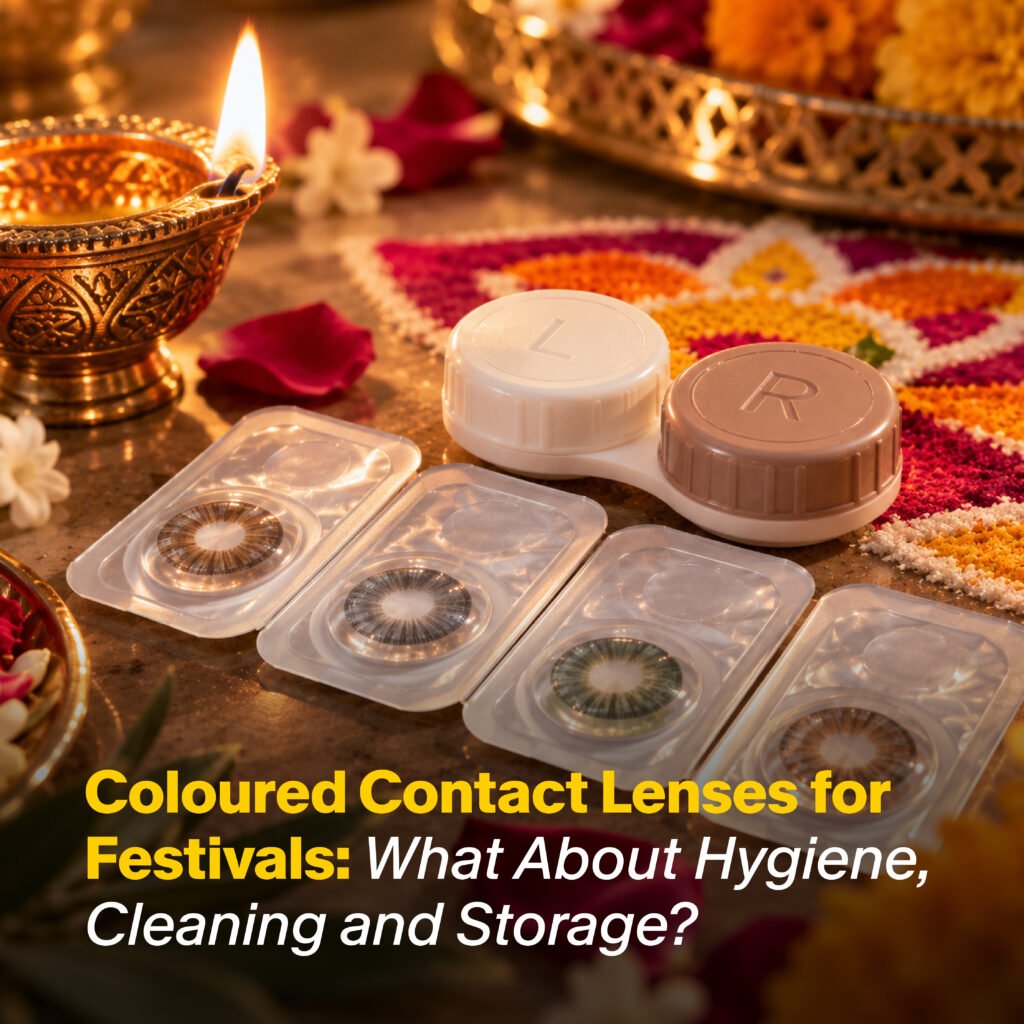
Introduction Festival season brings out coloured contact lenses like nothing else. Deep browns, honey hazels, striking greys, vivid greens, even dramatic costume lenses for themed events. For a few hours, they can completely transform how you look. And for those same few hours, they sit directly on your cornea, the most sensitive surface on your body. The problem is that most people who wear coloured lenses for special occasions treat them as a costume accessory rather than a medical device. They skip cleaning. They share lenses with friends. They sleep in them because the evening ran late. They store them in water when they forget to bring a solution. Every one of these habits carries the same risks whether the lens is a prescription lens or a purely cosmetic coloured one. The eye does not distinguish. Are Coloured Contact Lenses Safe to Wear for Festivals? The short answer Yes, when they are sourced correctly and cared for properly. No, when they are purchased from unregulated sources, shared between wearers, or used without basic hygiene practices. Why sourcing matters before hygiene even begins? Can I wear coloured contact lenses for a festival? You can, but the lens must come from a reputable optical or licensed retailer, ideally with a prescription or at minimum a professional fitting consultation. Coloured contact lenses sold at costume shops, market stalls, or through unverified online retailers are frequently manufactured without the quality controls applied to licensed contact lenses. Lenses from unregulated sources may use pigments that leach from the lens material into the tear film. They may not be manufactured to the oxygen permeability standards that protect corneal health. They may be mislabelled in terms of base curve and diameter, meaning they do not fit correctly and cause mechanical damage to the corneal surface during wear. A lens that fits correctly, is made from appropriate materials, and comes with proper care instructions is the starting point for safe festival wear. Everything after that depends on hygiene. Why hygiene matters even for short occasional wear? Many people assume that wearing coloured lenses for a few hours at an event is low risk compared to daily prescription lens wear. This assumption is incorrect. Infection risk from contact lens wear is not purely a function of total wear time. It is a function of lens cleanliness, fit, and the conditions of wear. A contaminated lens worn for four hours at a festival carries exactly the same infection risk as a contaminated lens worn for twelve hours on a regular day. The pathogens on that lens surface are just as capable of causing harm regardless of how festive the occasion. How Should You Clean Coloured Contact Lenses? How do I clean coloured contact lenses correctly? The cleaning process for coloured lenses is identical to that for clear prescription lenses. There is no shortcut that is appropriate simply because the lenses are worn less frequently. The Rub and Rinse Method Place the lens in your clean, dry palm. Apply several drops of fresh multipurpose contact lens solution. Using the pad of your index or ring finger, rub the lens gently for ten to fifteen seconds on each side. This physical action removes protein, lipid, and any cosmetic deposits accumulated during wear. Rinse the lens thoroughly with fresh solution after rubbing. The rinsing step flushes away the loosened deposits and any residual solution from the cleaning step. Do not skip the rinse. Can I use regular contact lens solution for coloured lenses? Yes. A quality multipurpose contact lens solution is appropriate for coloured contact lenses of the same material types used for standard soft lenses. The cleaning and disinfecting chemistry works the same way regardless of whether the lens is clear or pigmented. What you should not use is water of any kind, saline without disinfecting agents, or homemade cleaning solutions. These do not disinfect the lens and in the case of water introduce the risk of Acanthamoeba contamination, one of the most serious contact lens infections and one that is associated specifically with water contact during lens wear or storage. Cleaning After Festival Makeup Festival events typically involve more elaborate eye makeup than everyday wear. Kajal, dramatic liners, heavy eyeshadow, and face paint all increase the cosmetic particle load on the lens surface. On festival days, cleaning needs to be more deliberate than usual. Apply the rub and rinse method thoroughly on both sides, paying attention to the entire lens surface rather than a quick central rub. Festival makeup residue is more stubborn than everyday tear deposits and requires the full physical cleaning action to remove properly. Multisol+ by Gaymed Labs Multisol+ is a multipurpose contact lens solution from Gaymed Labs formulated to clean, rinse, disinfect, and store soft contact lenses including coloured lenses. With effective disinfecting agents and surfactants designed to remove deposits thoroughly, it supports the complete lens care that festival wear demands. Manufactured in a GMP and ISO 13485-certified facility with over 30 years of optical care expertise. How Should You Store Coloured Contact Lenses? How should I store coloured contact lenses between uses? Proper storage is where coloured lens hygiene most commonly breaks down, particularly when lenses are worn only occasionally for events rather than daily. Use a Clean Lens Case With Fresh Solution Every Time Place cleaned lenses in a lens case that has been emptied, rinsed with fresh solution, and air dried since its last use. Fill each well completely with fresh multipurpose contact lens solution. The lens must be fully submerged. Never top off old solution. Solution that has been sitting in the case since the last time the lenses were worn, whether that was last week or last month, has depleted disinfecting agents that cannot be restored by adding a small amount of fresh solution. Empty completely and refill entirely every time. The Problem With Infrequent Use Coloured lenses worn only for special occasions are stored for extended periods between uses. This creates a specific challenge that daily lens wearers do not
Can You Wear Contact Lenses With Eye Makeup? 7 Things to Know Before the Festive Season
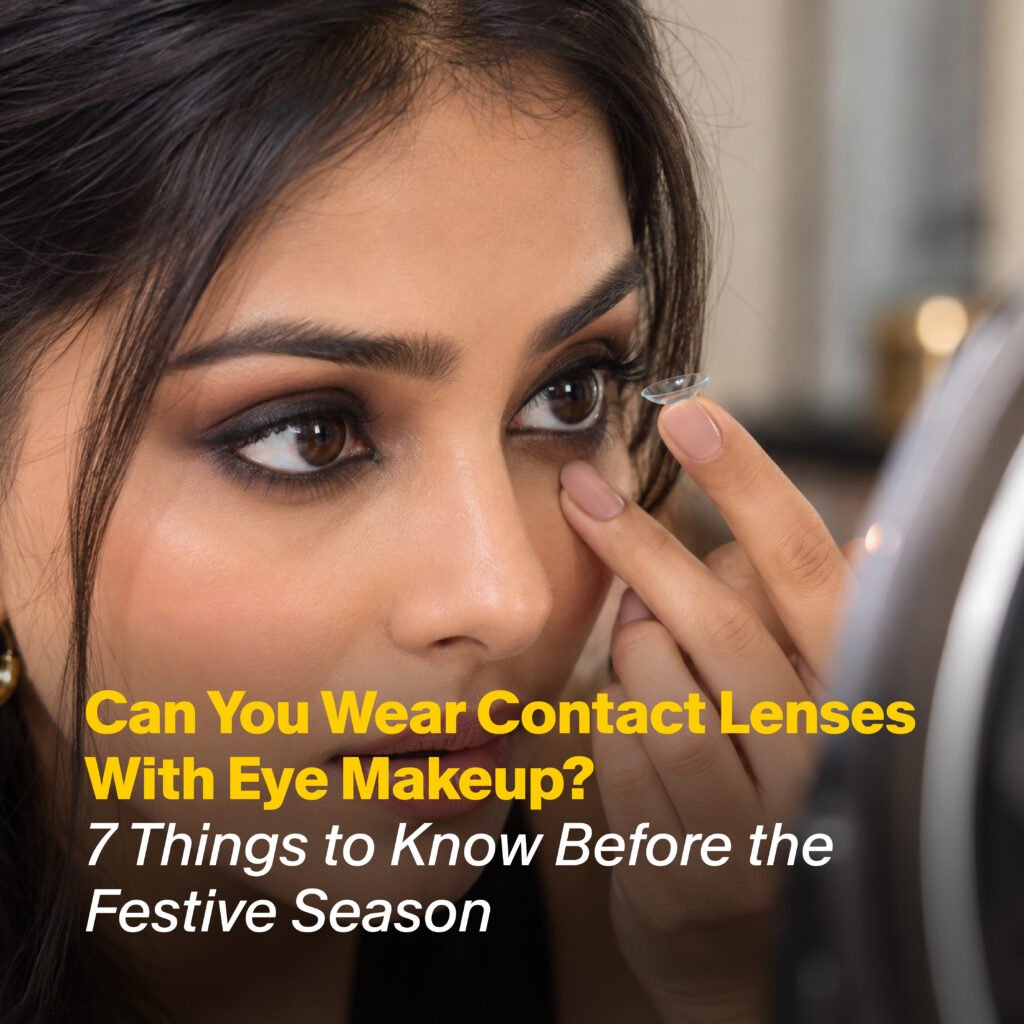
Introduction Festive season means longer days, late nights, and significantly more elaborate eye makeup than your average Tuesday. Kajal, eyeliner, eyeshadow, mascara, sometimes all of them together. If you wear contact lenses, this combination raises practical questions that most wearers figure out by trial and error, often at the cost of uncomfortable eyes or a ruined evening. The good news is that wearing contact lenses and eye makeup together is entirely manageable. You just need to know the rules before you start, not after your kajal has migrated onto your lens surface and your eyes are watering through a function. Here are seven things every lens wearer should know before the festive season begins. 1. Always Put Your Lenses in Before Applying Makeup Should I put contact lenses in before or after makeup? Lenses go in first, every single time. This is the foundational rule of combining contact lenses and eye makeup, and it is the one most frequently reversed. When you insert lenses before makeup, your hands are clean, your eye area is product-free, and the lens goes onto a clean ocular surface. When you insert lenses after applying mascara, eyeliner, or eyeshadow, you introduce whatever is on your fingertips and around your eye area directly to the lens surface. Even if you washed your hands after applying makeup, residual product around the eye transfers to the lens during insertion. Starting with clean lenses on a makeup-free eye area is the single most effective step for keeping your lenses comfortable throughout the day. 2. Makeup Particles Contaminate Lenses More Than You Realise Can makeup damage contact lenses? Yes, in ways that go beyond simple discomfort. Makeup particles that reach the lens surface create a film that is distinct from ordinary protein and lipid deposits. Cosmetic formulations contain oils, waxes, pigments, and in the case of glitter or shimmer products, fine physical particles that sit on the lens surface and interact poorly with the tear film. These particles change how the lens feels against the eye and how light passes through it. They also accelerate deposit accumulation because the cosmetic residue provides additional surfaces for proteins and lipids to adhere to. A lens that might normally remain comfortable for 12 to 14 hours may become uncomfortable several hours earlier on a heavy makeup day. Eyeliner applied to the waterline is particularly problematic. The waterline sits directly adjacent to the tear film, and anything applied there has a direct route onto the lens surface. Kajal and kohl products applied along the inner rim of the eyelid transfer to the tear film within minutes of application and from there to the lens. 3. Waterproof Makeup Requires Extra Caution Can I wear waterproof makeup with contact lenses? You can, but with awareness of the specific challenges it creates. Waterproof formulations are designed to be resistant to moisture, which is what makes them effective for long events or humid weather. This same property makes them more difficult to remove thoroughly at the end of the day. Waterproof mascara and eyeliner that reach the lens surface are harder to lift off during cleaning than standard formulations. They require more thorough cleaning with fresh contact lens solution and the rub and rinse method applied carefully to both sides of the lens. Waterproof makeup remover products often contain oils that help dissolve the formulation. These oil-based removers should not contact your lenses. Remove your lenses before using any oil-based makeup remover, and clean your eye area thoroughly before reinserting lenses if required. How Does Eye Makeup Affect Contact Lenses? Common Issues That Develop During Makeup Wear Dryness and reduced comfort. Cosmetic particles in the tear film disrupt its lipid layer, the outermost component that controls evaporation. This accelerates tear film breakdown and makes lenses feel dry earlier in the wearing period than usual. Blurred vision. Mascara or eyeliner particles on the lens surface create localised disruptions to optical clarity. This produces a smeared or hazy visual quality that cannot be blinked clear and does not resolve until the lens is removed and cleaned. Deposits that resist standard cleaning. Cosmetic residue bonds differently to lens surfaces than protein and lipid deposits from tears. Some formulations, particularly long-wear products, require more thorough cleaning to remove fully. Irritation and redness. Cosmetic particles that reach the space between the lens and the cornea cause physical irritation. The eye responds with redness, tearing, and discomfort that worsens with continued wear. 4. Choose Makeup Formulations That Are Lens-Friendly Not all eye makeup is equally problematic for contact lens wearers. A few formulation choices make a meaningful difference to lens comfort throughout the day. Avoid heavily pigmented or glittery eyeshadows for extended lens-wearing events. Fine pigment and glitter particles are particularly likely to migrate and reach the lens surface. Water-based formulations are generally less problematic than oil-based ones because they do not disrupt the lipid layer of the tear film as aggressively. Avoid applying eyeliner to the waterline if you are wearing contact lenses. This is the most direct route for product to reach your tear film and lens surface. Applying liner above or below the lash line rather than on the inner rim reduces this risk significantly. Choose mascaras that do not flake. Flaking mascara is a significant source of lens contamination throughout the day, releasing particles each time you blink. 5. Your Lens Care Routine Needs to Be More Thorough on Makeup Days How should I clean lenses after wearing makeup? Standard lens cleaning is necessary every day. On makeup days, it needs to be more deliberate. Use the full rub and rinse method with fresh multipurpose contact lens solution, not a shortened soaking-only approach. Apply several drops of fresh solution to the lens in your palm and rub gently for fifteen seconds on each side. This physical action is essential for removing cosmetic residue that soaking alone does not lift. Rinse thoroughly with fresh solution before placing the lens in the case. Fill the case with completely fresh solution for