
Introduction
Festival season is wonderful for everything except your glasses. Between the foundation that transfers from your nose bridge, the kajal that somehow migrates upward, the sweat from hours of dancing, the smoke from diyas and fireworks, and the repeated adjustments you make to your frames throughout the day, your lenses take an extraordinary amount of abuse in a very short time.
By mid-event, what started as perfectly clear lenses have turned into a smudged, hazy surface that you are constantly trying to wipe clean with whatever is nearest. Which, unfortunately, usually makes things worse.
Understanding why festival conditions are particularly hard on glasses lenses helps you manage the problem properly rather than creating new problems while trying to solve the existing one.
Why Do Glasses Get Smudged So Easily?
Why do my glasses get smudged so quickly during events?
Under normal daily conditions, the primary sources of lens smudging are skin oils from your nose bridge and fingerprints from adjusting the frames. During festivals, you add several additional contamination sources simultaneously.
- Makeup Transfer is one of the most significant contributors. Foundation, BB cream, and face primer applied to the nose and cheeks make direct contact with the nose pads and the section of the frame that rests against your face. From there, these products transfer to the frame and eventually to the lens edge and surface. Heavy eye makeup including kajal, eyeshadow pigment, and mascara particles migrate throughout the day. Sweat accelerates this migration by providing a liquid medium through which cosmetic products travel from the skin surface to the lens.
- Sweat and Humidity during dancing, outdoor events, and the general warmth of festive gatherings create a thin film of moisture on the skin that carries skin oils, makeup, and environmental particles toward the lens surface. In humid conditions, this film accumulates faster and transfers more readily to the lens than in dry conditions.
- Pollution and Fireworks Particles settle on lens surfaces continuously during outdoor exposure. Fine particulate matter from fireworks smoke, dust from outdoor venues, and general urban pollution all add to the smudge load on lenses during festival periods.
- Frequent Handling is the factor that compounds all of the above. Every time you push your glasses up your nose, adjust the temples, or remove and reinsert them, you transfer whatever is on your fingertips to the frame and lens. During a long festival event, this happens dozens of times.
Can Makeup and Sweat Damage Your Glass Lenses?
Makeup itself does not directly damage lens coatings in the way that harsh chemicals do. The damage comes from what people do when trying to remove makeup from their lenses, and from the repeated friction of wiping that occurs when lenses get smudged repeatedly throughout an event.
When lenses are smudged with a combination of foundation, kajal, and sweat, the natural response is to grab the nearest material and wipe. During a festival, this usually means a dupatta, a tissue, a paper napkin from the catering table, or a regular cloth. Each of these materials is abrasive at a microscopic level.
The fine scratches they create are individually invisible but collectively produce the haze that develops on lenses over months of incorrect cleaning.
Sweat presents a specific chemical concern for lens coatings. Human sweat is slightly acidic, with a pH typically between 4.5 and 7.5. Repeated contact of sweat with anti-reflective coatings, particularly when followed by wiping before the sweat has been rinsed away, creates a mild chemical exposure that compounds over time.
Anti-reflective coatings that are repeatedly exposed to sweat and then wiped with abrasive materials degrade faster than those maintained with proper cleaning.
Why the Right Cleaning Method Matters Even More at Events
The importance of using proper cleaning tools and products becomes even more pronounced during festival conditions because the smudging is more frequent, the contamination is more varied, and the temptation to reach for whatever is nearby is at its highest. Each incorrect wipe during an event is a scratch. Each scratch accumulates toward permanent coating damage that cannot be reversed.
What Is the Best Way to Clean Smudged Glasses?
The correct method is the same as it is at home, applied with the right tools that you need to carry with you.
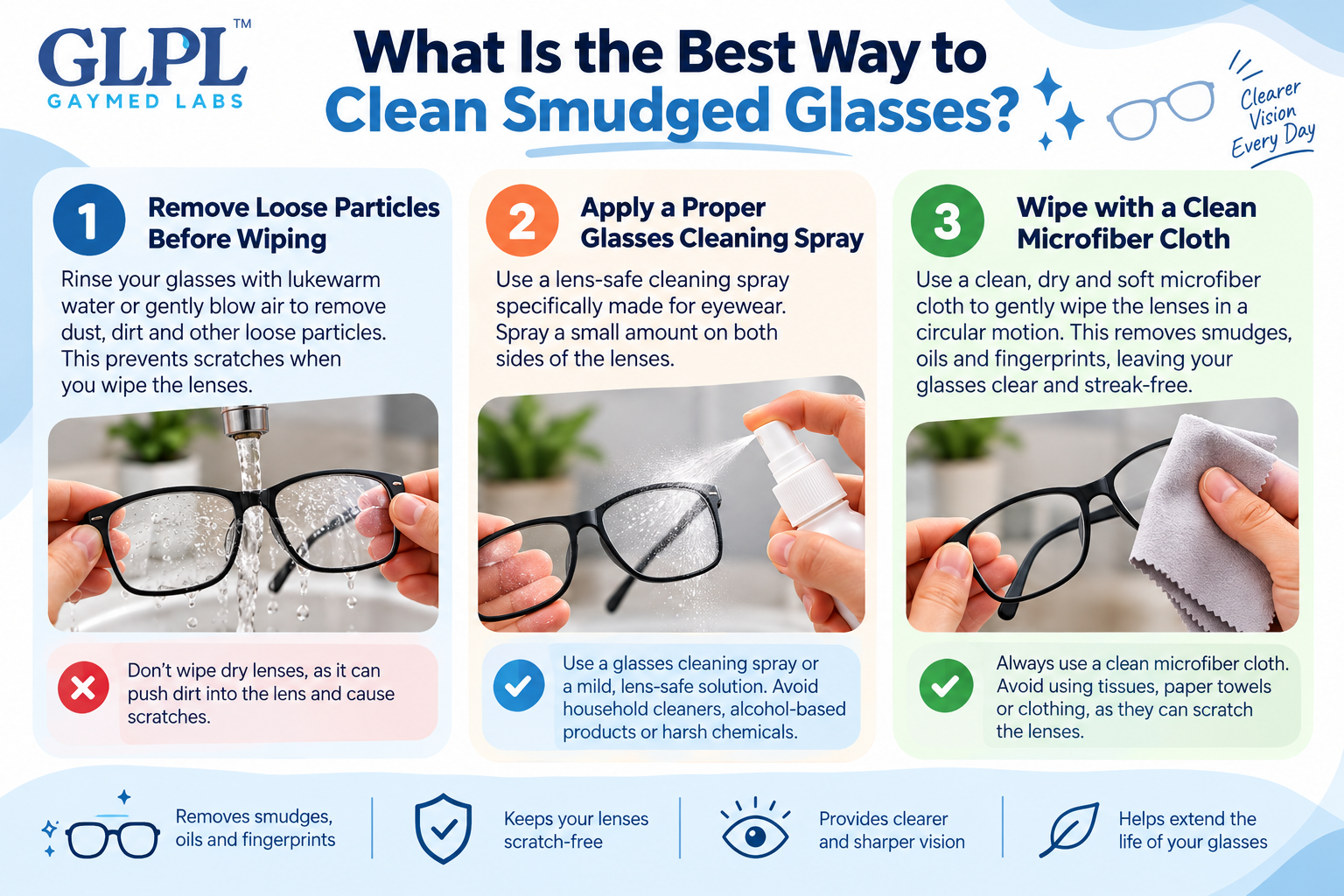
Step One: Remove Loose Particles Before Wiping
Before any cloth contacts your lens, remove loose particles by gently blowing on both sides of the lens. During festival conditions where dust, fireworks particles, and makeup residue are present, this step is especially important. Wiping a lens that has fine particles sitting on it drags those particles across the coating surface under pressure.
If water is available and you are near a clean sink, a brief rinse under lukewarm water before wiping is even better for removing loose abrasive particles.
Step Two: Apply a Proper Glasses Cleaning Spray
Apply two to three sprays of a dedicated glasses cleaner spray to both sides of the lens. A proper glasses cleaning spray is pH-balanced and formulated to be safe for anti-reflective, UV, and blue-light coatings. It contains mild surfactants that lift makeup residue, skin oils, and sweat from the lens surface without interacting chemically with the coatings beneath.
This is where the cleaning method matters most. Household products that might be nearby at a festival venue such as hand sanitiser, wet wipes, multi-surface sprays, or perfume should never be used on spectacle lenses. Hand sanitiser contains high-concentration alcohol that strips hydrophobic and anti-reflective coatings. Multi-surface sprays often contain ammonia. Even wet wipes not designed for optical surfaces can leave residue and cause coating damage.
Step Three: Wipe with a Clean Microfiber Cloth
Use a clean microfiber cloth for glasses to buff the lens gently in circular motions from the centre outward. The surfactants in the glasses cleaning spray have already loosened the smudge. The cloth’s job is to lift it away without scratching.
The emphasis on clean is important. A microfiber cloth that has been loose in your bag throughout the event has picked up particles, makeup, and debris. Using it on your lenses at the end of the night is barely better than using a regular cloth. Keep your cloth in a sealed pouch or clean zip bag to maintain its cleanliness throughout the event.
What Not to Use?
Tissues, paper napkins, dupattas, shirt hems, and any regular cloth are all inappropriate for lens cleaning. All of these materials create micro-scratches on optical coatings with repeated use, regardless of how soft they feel to the touch.
How Can You Keep Glasses Clean During Long Events?
The most effective approach to festival smudging is preparation rather than reactive cleaning. A few habits before and during the event significantly reduce how frequently cleaning is needed and ensure you have the right tools available when it is.
- Carry a small glasses cleaning kit. A pocket-sized glasses cleaner spray and a clean microfiber cloth in a sealed pouch take up almost no space in a bag or pocket. Having them available means you never need to reach for an inappropriate substitute when lenses get smudged.
- Keep a spare pouch for the microfiber cloth. A clean microfiber cloth for glasses needs to stay clean to remain effective. A small ziplock bag or the dedicated pouch it came in keeps it free from bag debris throughout the event.
- Apply a thin layer of face powder over makeup near the nose bridge. Setting the makeup closest to your frames with powder reduces transfer. Less product transfer means fewer smudges throughout the event.
- Handle glasses by the temples rather than the lenses. This is good practice at any time but particularly important at events where your hands are in contact with food, drinks, and general festive surfaces. Holding by the temples reduces fingerprint transfer onto the lenses dramatically.
- Store glasses in a hard case when not being worn. Between events or during portions of the celebration where you are not wearing them, a hard case prevents surface contact with other items that would smudge or scratch.
Rinsol Lens Cleaner and Rinsol Lens Wipes by Gaymed Labs
Rinsol Lens Cleaner spray from Gaymed Labs is a dedicated glasses cleaning spray formulated to be safe for all optical coating types, removing makeup residue, sweat, skin oils, and pollution particles effectively without damaging anti-reflective or UV coatings.
For festival portability, Rinsol Lens Wipes offer the same coating-safe cleaning performance in individually sealed, pre-moistened wipes that fit in any bag or pocket. Both products are manufactured in a GMP and ISO 13485-certified facility with over 30 years of optical care expertise from GLPL.
Conclusion
Festival conditions create a perfect combination of smudging factors. Makeup migration, sweat, pollution, and frequent handling all contribute to lenses that cloud up faster than they do on any ordinary day. The damage comes not from the smudging itself but from the repeated incorrect wiping that happens in response to it.
The solution is simple and portable. A proper glasses cleaning spray, a clean microfiber cloth in a sealed pouch, and the habit of blowing loose particles off before wiping. These three things, carried with you to every festive event, protect your lenses from the cumulative micro-scratch damage that incorrect festival cleaning causes and keep your vision clear throughout the celebration.
Frequently Asked Questions
1. Why do my glasses get smudged so quickly at festivals?
Festival conditions combine multiple simultaneous smudging sources. Makeup migration from the skin and eye area. Sweat carrying skin oils and cosmetic products to the lens surface. Pollution and fireworks particles settling on lenses. And frequent handling that transfers fingertip oils with every adjustment. Together, these produce significantly faster smudge accumulation than normal daily conditions.
2. Can makeup damage spectacle lenses?
Makeup itself does not directly damage lens coatings, but the repeated wiping response to makeup smudging does. Grabbing tissues, dupattas, or any non-optical material to clean makeup-smudged lenses creates micro-scratches on optical coatings that accumulate into permanent haze over time.
3. What is the best way to clean glasses during a festival?
Remove loose particles by blowing on the lens first. Apply a dedicated glasses cleaning spray to both sides of the lens. Wipe gently with a clean microfiber cloth in circular motions from the centre outward. Never use tissues, paper napkins, hand sanitiser, or regular wipes on spectacle lenses.
4. Can I use a microfiber cloth to clean my glasses?
Yes, and it is the recommended material for lens cleaning. The key is that the cloth must be clean. A microfiber cloth that has been loose in a bag throughout an event carries particles that can scratch lenses. Keep yours in a sealed pouch to maintain its cleanliness throughout the day.
5. How often should I clean my glasses during a long event?
As often as needed to maintain clear vision, using the correct method and tools each time. At festivals, this may be more frequent than your usual routine. The priority is never to clean with an inappropriate material regardless of how convenient it seems at the moment.
For more information on eye care and lens maintenance, visit gaymedlabs.com