
Why Eye Care Clinics Recommend Multipurpose Contact Lens Solutions Over DIY Cleaning Methods
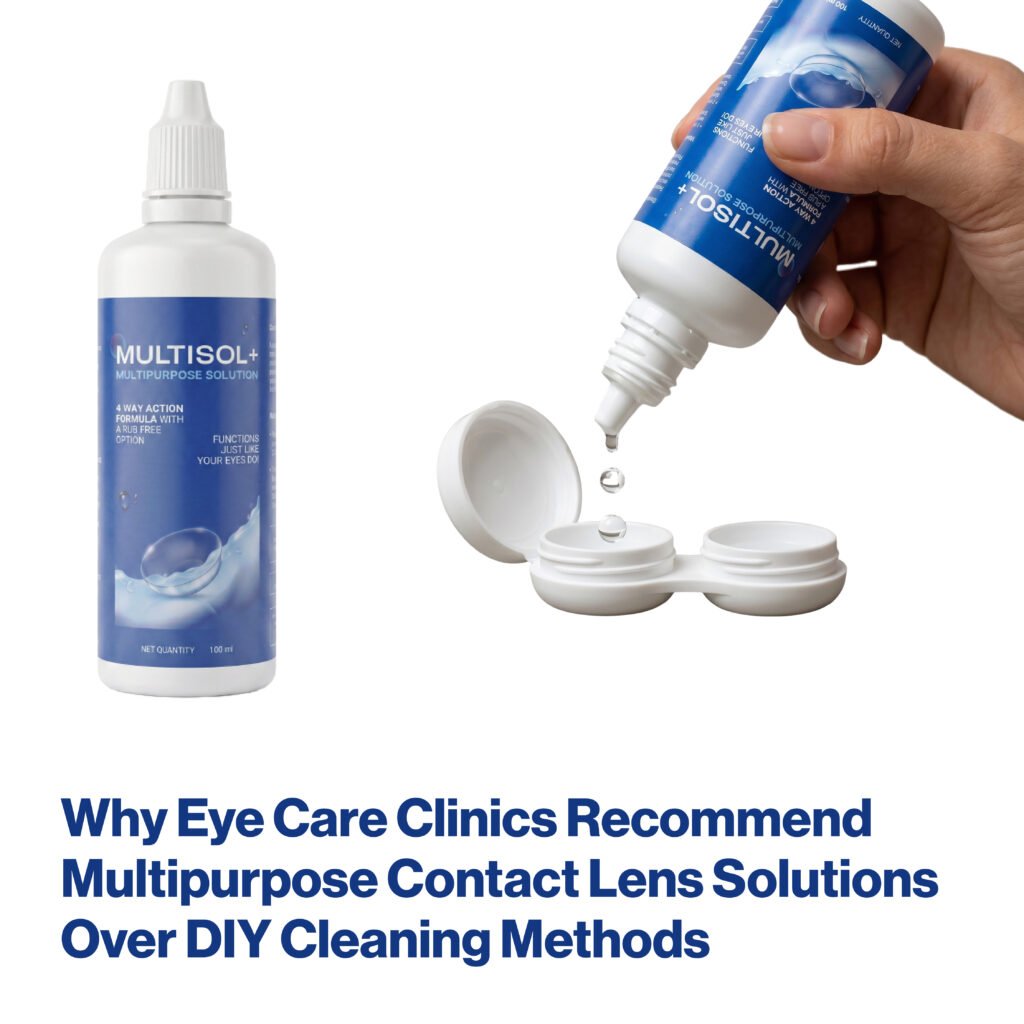
Introduction Every so often, a DIY contact lens solution recipe circulates online. Distilled water with a pinch of salt. A drop of baby shampoo mixed into saline. Boiled tap water left to cool. The logic seems reasonable enough. Clean, sterile-sounding ingredients, a fraction of the cost of a proper solution, and the immediate convenience of making it at home. Eye care professionals see the consequences of these recipes regularly. Not because people are careless, but because the gap between what a homemade solution looks like and what it actually does to your eyes is far wider than most people realise. This blog explains exactly why clinics consistently recommend proper multipurpose contact lens solutions, and why the alternatives carry risks that simply are not worth taking. Why Do Eye Care Professionals Recommend Proper Lens Solutions? The Clinical Foundation of Lens Solution Development A sterile contact lens solution that reaches the pharmacy shelf has gone through an extensive development and testing process before it is approved for use. Formulations are tested for antimicrobial efficacy against specific pathogens known to cause contact lens infections. pH and osmolarity are measured and calibrated to match the natural tear environment. Compatibility with different lens materials is assessed to ensure the solution cleans without degrading the lens structure. This level of testing exists because contact lenses sit directly on the cornea, one of the most sensitive and infection-vulnerable surfaces in the human body. The eye has limited natural defence mechanisms against pathogens introduced via a contact lens. A solution that reaches the eye through a lens must be genuinely sterile, genuinely effective, and genuinely safe for the specific tissues it will contact. Why do eye doctors warn against using homemade saline for contacts? Because homemade saline, regardless of how carefully it is prepared, cannot replicate the sterility and formulation precision of a factory-manufactured sterile contact lens solution. This is not a commercial bias. It is a straightforward matter of microbiology and manufacturing standards. A home kitchen is not a sterile environment. The equipment used to prepare homemade solutions is not pharmaceutical-grade. The salt used is not measured with the precision required to produce a truly isotonic solution. And once prepared, a homemade mixture has no preservative system to maintain sterility over time. Risks of DIY Contact Lens Cleaning Methods Can I make a safe DIY contact lens solution at home? The honest clinical answer is no. Not because the intention is wrong, but because the requirements for a genuinely safe lens solution cannot be met in a home setting. Here is what those requirements actually involve. The water used must be sterile, not just boiled or filtered. Boiling kills many but not all microorganisms. Acanthamoeba, the organism responsible for one of the most serious contact lens infections, forms cysts that are resistant to boiling. Distilled water removes many contaminants but does not sterilise. Even water that tests clean for drinking purposes is not clean enough for direct contact with a contact lens sitting on your cornea. The salt concentration in a homemade saline must be exactly 0.9 percent sodium chloride to match the tonicity of natural tears. A slight excess causes the lens to shrink. A slight deficiency causes it to swell. Measuring this accurately with kitchen equipment and standard table salt is not reliably achievable. Even a small deviation affects lens comfort and can cause pain upon insertion. And critically, a homemade solution contains no disinfecting agents whatsoever. It cannot kill bacteria. This solution cannot eliminate fungi. It cannot address Acanthamoeba. It is, at best, an impure rinse solution with no active protective capability. What are the medical risks of using DIY contact cleaners? The medical risk profile of DIY contact lens cleaning is significant and well documented in clinical literature. Acanthamoeba keratitis: This infection is almost exclusively associated with water contact during contact lens wear or storage. It causes intense, progressive pain, extreme light sensitivity, and in severe cases, permanent corneal scarring that requires transplant surgery to address. The organism is present in tap water, filtered water, and some bottled water sources. No home preparation method reliably eliminates it. Microbial keratitis: Bacterial corneal infections from contaminated lenses are among the most common serious complications of contact lens wear. Organisms like Pseudomonas aeruginosa can progress from initial infection to significant corneal damage within 24 hours. A proper contact lens cleaning solution contains disinfecting agents specifically tested against these pathogens. A homemade solution has none. Chemical corneal burns: Homemade solutions that incorporate inappropriate ingredients, including higher concentrations of any cleaning agent, can cause chemical injury to the corneal surface. The cornea has no pain receptors at its surface layers that warn you before damage occurs. By the time significant pain develops, meaningful tissue damage may already be present. How Multipurpose Contact Lens Solutions Protect Eye Health? How do factory-made lens solutions protect eyes better than DIY methods? The answer lies in what factory manufacturing actually provides that a home kitchen cannot. Guaranteed sterility: Commercial contact lens solutions are manufactured under pharmaceutical-grade sterile conditions. The water used is not just purified but rendered completely free of viable microorganisms through validated sterilisation processes. This sterility is maintained by a preservative system that keeps the solution safe from the moment the bottle is opened until its stated discard date. Precise pH and osmolarity: Every batch of commercial solution is tested to ensure its pH sits within the narrow range that is comfortable and safe for eye contact. The tonicity is calibrated to match natural tears. These parameters are maintained batch to batch through quality control testing that is simply not replicable at home. Validated antimicrobial efficacy: The disinfecting agents in a commercial contact lens cleaning solution are present at concentrations that have been validated to eliminate specific pathogens within specific soaking times. This validation is based on standardised testing against the organisms most commonly implicated in contact lens infections. Lens material compatibility: Commercial solutions are tested for compatibility with specific lens materials. This ensures the solution cleans without degrading the
How to Choose the Right Contact Lens Solution for Your Eyes
Introduction Standing in front of a pharmacy shelf full of contact lens solutions can be genuinely overwhelming. Different brand names, different formulations, different claims about comfort and hydration and sensitivity. Most wearers eventually pick one based on price or familiarity and stick with it indefinitely, rarely questioning whether it is actually the best choice for their specific eyes. The right contact lens solution is not the same for everyone. Your lens material, your tear chemistry, your sensitivity profile, and your daily wearing patterns all influence which formulation actually serves your eyes well. Choosing incorrectly does not always cause obvious problems immediately, but it can contribute to cumulative discomfort, deposit buildup, and in some cases, genuine eye health issues over time. Why Choosing the Right Contact Lens Solution Matters? How do I know which contact lens solution is best for me? The answer starts with understanding what your solution is actually being asked to do for your specific situation. A contact lens solution handles four distinct functions every day. It cleans the lens surface by removing protein, lipid, and debris deposits. The solution disinfects by eliminating bacteria, fungi, and other microorganisms. It rinses the lens of loosened contaminants before insertion. And it stores the lens while maintaining its hydration and structural integrity overnight. How well a solution performs each of these functions depends on its specific formulation. And how well that formulation suits you depends on your individual lens type, eye sensitivity, and comfort needs. A solution that works beautifully for one wearer can cause persistent irritation for another wearing a different lens material with different tear chemistry. Getting this choice right means clearer, more comfortable lens wear every day and meaningfully lower risk of the complications that arise from inadequate cleaning or incompatible chemistry. Types of Contact Lens Solutions Available 1. Multipurpose Solutions A multipurpose contact lens solution is the most commonly used category and for most wearers the most practical starting point. It handles all four daily care functions in a single product, making the routine straightforward and consistent. Quality multipurpose solutions contain disinfecting agents, surfactants for deposit removal, conditioning ingredients for lens hydration, and buffering agents for pH balance. The best contact lens cleaning solution in this category balances all of these functions without compromising any one of them. The convenience of a single-bottle system suits the majority of daily lens wearers and removes the complexity of managing multiple products. 2. Hydrogen Peroxide Systems Hydrogen peroxide systems offer a deeper, preservative-free clean that is particularly beneficial for wearers with sensitivity to the preservatives used in standard multipurpose solutions. The system uses a specialised case with a built-in neutralising disc that converts the hydrogen peroxide into harmless saline over a minimum soaking period of six hours. The critical point about hydrogen peroxide systems is that the lenses must complete the full neutralisation cycle before insertion. Placing unneutralised hydrogen peroxide directly onto the eye causes an immediate and intensely painful chemical burn. This system requires more care in its use than a standard multipurpose solution but provides a genuinely superior clean for wearers who need it. 3. Saline Solutions Saline is sterile salt water with no disinfecting or cleaning capability. It is not a stand-alone lens care system and should never be used as a substitute for a proper contact lens solution. Its appropriate uses are limited to rinsing lenses after hydrogen peroxide neutralisation in specific care systems, and occasionally as a lens or eye rinse in situations where no other option is available. Factors to Consider When Choosing a Contact Lens Solution 1. Your Lens Type and Material What is the best lens solution for silicone hydrogel lenses? Silicone hydrogel lenses have a different surface chemistry from traditional hydrogel lenses and can interact differently with certain solution formulations. Some multipurpose solutions are not optimised for silicone hydrogel surfaces and may leave deposits or cause discomfort specific to this material. Look for a solution that explicitly states compatibility with silicone hydrogel lenses. Many modern multipurpose formulations include specific wetting agents designed for silicone hydrogel surface chemistry. Your eye care professional can confirm compatibility based on your specific lens brand and material. Are all multipurpose contact lens solutions the same? They are not, despite looking similar on the shelf. Differences in disinfecting agents, surfactant systems, conditioning ingredients, and pH buffering mean that different formulations perform differently for different wearers. Two products both labelled as multipurpose solutions can have meaningfully different profiles in terms of disinfecting efficacy, deposit removal capability, and compatibility with specific lens materials. 2. Your Sensitivity Profile How do I choose a contact solution if I have highly sensitive eyes? Sensitive-eye wearers need to pay particular attention to the preservative system in their solution. Benzalkonium chloride, or BAK, is a preservative effective in many ophthalmic products but associated with surface toxicity in some wearers with chronic exposure. Most modern multipurpose solutions use gentler alternatives, but checking is worthwhile if sensitivity is a persistent issue. For wearers with significant preservative sensitivity, a hydrogen peroxide system eliminates preservative exposure entirely, since the solution neutralises completely before the lens contacts the eye. 3. Your Dryness and Comfort Needs What contact lens solution do eye doctors recommend for dry eyes? For wearers experiencing end-of-day dryness, the conditioning and humectant ingredients in a solution matter significantly. Formulations containing hyaluronic acid provide superior moisture retention compared to those using only basic wetting agents. Hyaluronic acid binds moisture to the lens material during storage and helps maintain hydration during wear. If dryness is your primary complaint with lens wear, prioritising a solution with a strong hydrating formulation is often the most impactful single change you can make to your lens care routine. Ingredients to Look for in a Contact Lens Solution Understanding key ingredients helps you evaluate solutions beyond marketing claims. Disinfecting Agents: Polyhexamethylene biguanide, known as PHMB, and Polyquaternium-1 are widely used and well-tolerated antimicrobial agents. They provide broad-spectrum protection against bacteria and fungi while remaining gentle enough for daily eye contact Surfactants: Poloxamer
Can Contact Lens Solution Help Reduce Protein Deposits on Lenses?
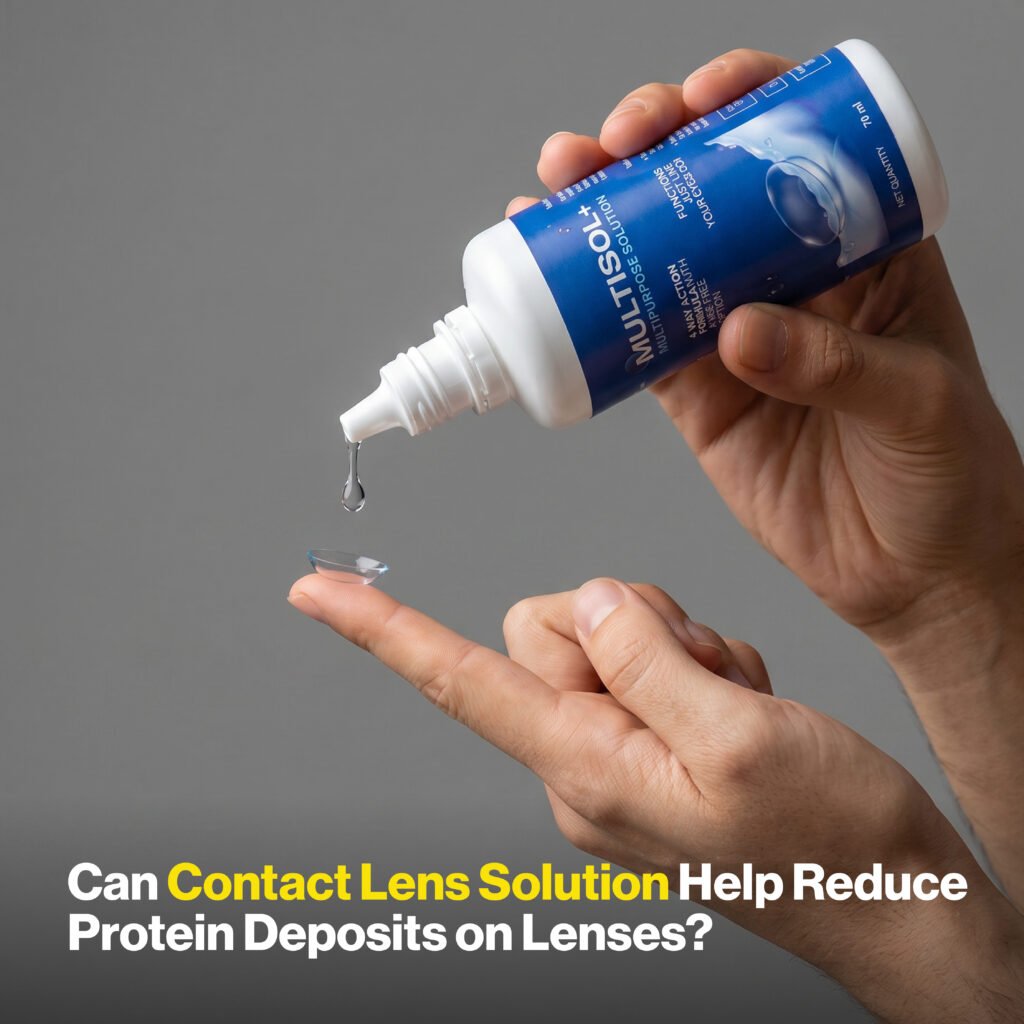
Introduction You put your contact lenses in and everything is clear. A few days later, the same lenses look cloudy, feel uncomfortable, and your vision seems slightly hazy even though your prescription has not changed. The culprit in most cases is protein deposits, and it is one of the most common and most misunderstood aspects of contact lens wear. Understanding what these deposits are, why they build up, and how your contact lens solution addresses them is fundamental to maintaining comfortable, clear vision throughout your lens replacement cycle. What Are Protein Deposits on Contact Lenses? Why do my contact lenses get a cloudy film on them? This is one of the most frequently searched questions among contact lens wearers, and the answer lies in the chemistry of your own tears. Your tear film is not just water. It contains a complex mixture of proteins, lipids, mucins, electrolytes, and growth factors. Lysozyme is one of the most abundant proteins in human tears and plays an important role in protecting your eyes from infection. The problem is that when lysozyme and other tear proteins come into contact with the synthetic surface of a contact lens, they undergo a process called denaturation. Denaturation means the protein loses its natural structure and bonds to the lens surface in a distorted form. Over hours and days of wear, these denatured proteins accumulate and link together into a film that becomes progressively thicker and harder to remove. Lipids from the eye’s oil glands also deposit alongside proteins, and together they create the cloudy, greasy film that makes lenses look dirty and feel uncomfortable. This is not a sign of poor hygiene necessarily. It is a natural consequence of wearing a foreign surface on your eye in contact with your biological tear film. The right cleaning routine manages it. The wrong routine allows it to compound. Why Do Protein Deposits Affect Lens Comfort? What causes blurry vision on contact lenses after a few days? Protein and lipid deposits on the lens surface affect your vision and comfort through several mechanisms simultaneously. Optically, deposits scatter light rather than allowing it to pass cleanly through the lens. This is why lenses that were perfectly clear on day one develop a hazy, cloudy quality over subsequent days. The deposit film is not uniform, so different areas of the lens scatter light differently, creating uneven blur rather than a consistent reduction in clarity. Physically, the jagged molecular structure of denatured proteins creates a rough surface on the lens. Every blink drags this roughened surface across the conjunctival tissue lining your eyelid. Over hours of wear, this friction causes irritation, redness, and a persistent gritty sensation that worsens throughout the day. Biologically, protein deposits on contact lenses can trigger an immune response in some wearers. Giant papillary conjunctivitis, or GPC, is a condition where the immune system reacts to the deposit-laden lens surface, causing the formation of small bumps under the upper eyelid. Left unaddressed, GPC can make it impossible to wear contact lenses comfortably and in some cases at all. How Does Contact Lens Solution Help Remove Deposits? How do contact lens solutions break down daily eye deposits? A well-formulated contact lens cleaning solution addresses protein and lipid deposits through two complementary mechanisms, chemical and mechanical. The chemical mechanism relies on surfactants, the cleaning agents in your solution. Surfactants have a dual-affinity molecular structure with one end that attracts water and another that attracts organic matter like proteins and lipids. When the solution comes into contact with the deposit-laden lens surface, surfactant molecules surround the deposits, loosening their bond with the lens material and preparing them to be rinsed away. Some solutions also contain specific protein-removal ingredients such as hydroxyalkylphosphonate. These are targeted molecules designed to break down the denatured protein bonds specifically, rather than relying solely on general surfactant action. Their inclusion in a formula significantly improves the solution’s ability to address heavier protein accumulation. The mechanical mechanism is the physical rubbing step. When you place your lens in your palm and rub it gently with fresh solution for ten to fifteen seconds per side, you are physically disrupting the deposit layer and helping the surfactants do their work. This combination of chemical action and mechanical agitation removes substantially more deposit than soaking alone, regardless of what the product label claims about no-rub convenience. Does Every Contact Lens Solution Remove Protein Deposits? Does multipurpose solution automatically remove protein from contacts? Not all multipurpose solutions remove protein deposits equally, and this is a distinction worth understanding when choosing a contact lens care solution. Basic multipurpose solutions contain surfactants that address general surface cleaning, including some protein removal as part of their broader cleaning action. These are sufficient for most daily soft lens wearers who replace their lenses frequently, because short replacement cycles limit how much time deposits have to accumulate before the lens is discarded. Advanced formulas include dedicated protein-removing agents alongside their standard surfactant systems. These are particularly relevant for monthly lens wearers, for wearers whose tear chemistry produces higher than average protein content, and for anyone who has noticed a cloudy film developing before their replacement schedule is due. How do I get rid of protein buildup on my contact lenses? The most effective approach for managing existing protein buildup within a replacement cycle involves three things. First, using a solution with genuine protein-removal capability and following the rub and rinse method every single time rather than relying on soaking alone. Second, considering a dedicated enzymatic protein remover used on a weekly basis if you are a monthly lens wearer with significant deposit issues. Third, and most straightforwardly, following your replacement schedule. Protein buildup is cumulative. The most reliable way to eliminate it entirely is to start fresh with a new lens on schedule. How to Prevent Protein Buildup on Contact Lenses Follow the Rub and Rinse Method Every Time This is the most impactful single habit for managing protein deposits. Place the lens in your clean, dry
Soft Contact Lenses vs Rigid Gas Permeable Lenses: Does Lens Care Differ?
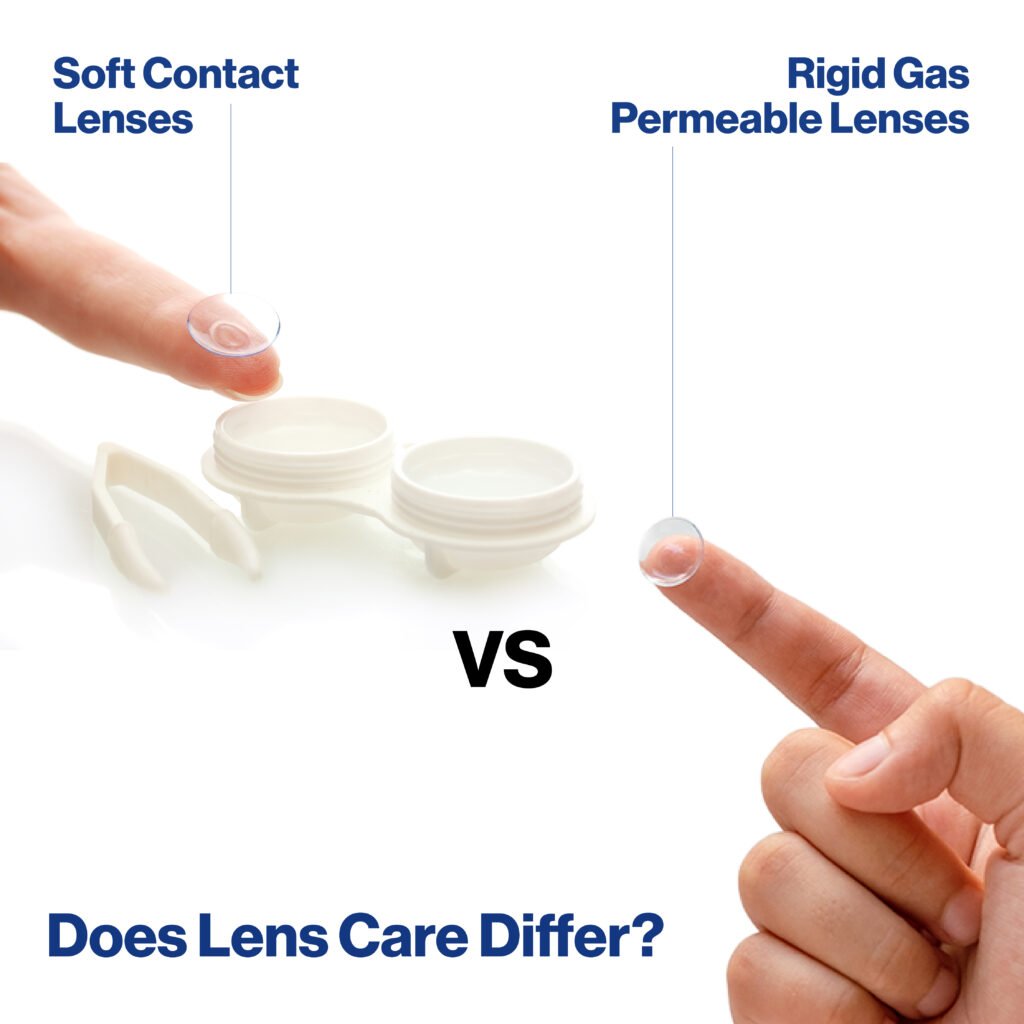
Introduction Most contact lens wearers use soft lenses and assume that contact lens care is broadly the same for everyone. It is not, and the differences matter more than most people realise. Soft lenses and rigid gas permeable lenses are made from fundamentally different materials with different surface properties, different deposit accumulation patterns, and different cleaning requirements. Using the wrong solution or the wrong technique for your lens type does not just reduce cleaning effectiveness. It can damage your lenses and put your eyes at risk. What Are Soft Contact Lenses and Rigid Gas Permeable Lenses? The Basics of Soft Lenses Soft contact lenses are made from hydrogel or silicone hydrogel materials that contain a significant proportion of water, typically between 38 and 75 percent depending on the specific material. This water content makes them flexible, comfortable from the first wear, and easy to adapt to. They conform to the shape of the cornea rather than holding a rigid form of their own. Most daily, bi-weekly, and monthly disposable lenses are soft lenses. They are the most widely prescribed lens type globally because of their immediate comfort and straightforward adaptation period. What Are Rigid Gas Permeable Lenses? Rigid gas permeable lenses, commonly referred to as RGP or GP lenses, are made from firm, oxygen-permeable plastic materials that do not contain water. Unlike the older hard lenses made from PMMA plastic, RGP lenses allow oxygen to pass through the lens material directly to the cornea, which is why they are called gas permeable. RGP lenses hold their shape on the eye rather than conforming to the corneal surface. They require a longer adaptation period than soft lenses but offer advantages including sharper optical clarity, greater durability, and lower deposit accumulation in some respects. They are also the lens of choice for certain corneal conditions including keratoconus. How Does Care Differ Between Soft and RGP Lenses? What is the difference between hard and soft contact lens care? The core difference comes down to material chemistry. Soft lenses are porous and water-containing. RGP lenses are firm and non-hydrating. These material differences affect which cleaning agents are safe, how deposits accumulate, and what the storage requirements look like. Soft lenses are more susceptible to protein and lipid deposition within the lens matrix itself, not just on the surface. Their porous structure means deposits can become embedded in the material over time. This is one reason soft lenses have replacement schedules measured in days, weeks, or months rather than years. RGP lenses accumulate deposits primarily on the lens surface rather than within the material. Because they are non-porous and hold their shape, they are more durable and can last one to two years with proper care. However, this durability comes with a more intensive daily cleaning requirement because protein deposits on a firm lens surface can harden and bond more stubbornly than on a soft lens. Cleaning Solutions for Soft vs RGP Lenses Can I use multipurpose soft lens solution on RGP lenses? This is one of the most common and most consequential mistakes in contact lens care. The short answer is no, and it is worth understanding exactly why. Multipurpose solutions for soft lenses are formulated specifically for hydrogel and silicone hydrogel materials. The surfactants, disinfecting agents, and conditioning ingredients are chosen for their compatibility with water-containing, flexible lens materials. Some of these ingredients can interact poorly with the rigid plastic materials used in RGP lenses, potentially causing surface damage or leaving residue that compromises optical clarity. RGP lenses require solutions specifically formulated for gas permeable materials. These exist as separate product categories for good reason. RGP Lens Cleaning Solutions RGP cleaning solutions contain surfactants optimised for firm, non-porous surfaces. They are designed to lift and remove the protein and lipid deposits that accumulate on a rigid surface without leaving any film that would affect the optical precision the lens is designed to deliver. Many RGP care systems involve more steps than a soft lens routine. A daily cleaner is used for the initial cleaning step, followed by a separate conditioning and soaking solution for overnight storage. Some wearers also use a separate weekly protein removal treatment, which brings us to an important distinction between the two lens types. Do Gas Permeable Lenses Need a Separate Protein Remover? Often yes, and this is one of the ways RGP care is more involved than soft lens care. Because RGP lenses are replaced far less frequently than soft lenses, protein deposits have significantly more time to accumulate and harden on the lens surface. A weekly enzyme or protein removal treatment specifically formulated for RGP lenses helps prevent this long-term buildup from compromising vision quality and comfort. Some daily RGP cleaners include protein-removing agents in their formula, but for long-term RGP wearers, a dedicated hard contact lens protein remover used on a regular schedule is often recommended by eye care professionals. Common Mistakes When Caring for Different Lens Types 1. Using Soft Lens Solution on RGP Lenses This is the single most common care mistake among wearers who switch between lens types or who are new to RGP lenses. Multipurpose solutions designed for soft lenses are not appropriate for RGP materials and should never be used as a substitute regardless of convenience. 2. Using RGP Solutions on Soft Lenses The reverse mistake is equally problematic. RGP solutions contain different concentrations of active ingredients and surfactants that may not be safe or effective for hydrogel materials. Always use the solution category that matches your specific lens type. 3. Skipping the Daily Cleaner Step for RGP Lenses Many soft lens wearers who transition to RGP lenses try to simplify their routine by skipping the separate daily cleaning step and going straight to the soaking solution. This leaves surface deposits inadequately removed and allows them to harden over time, affecting both clarity and comfort. 4. Not Rubbing RGP Lenses Adequately RGP lenses benefit from firm, deliberate rubbing during cleaning due to the harder nature of surface deposits on rigid
What Ingredients Should You Look for in a Multipurpose Contact Lens Solution?
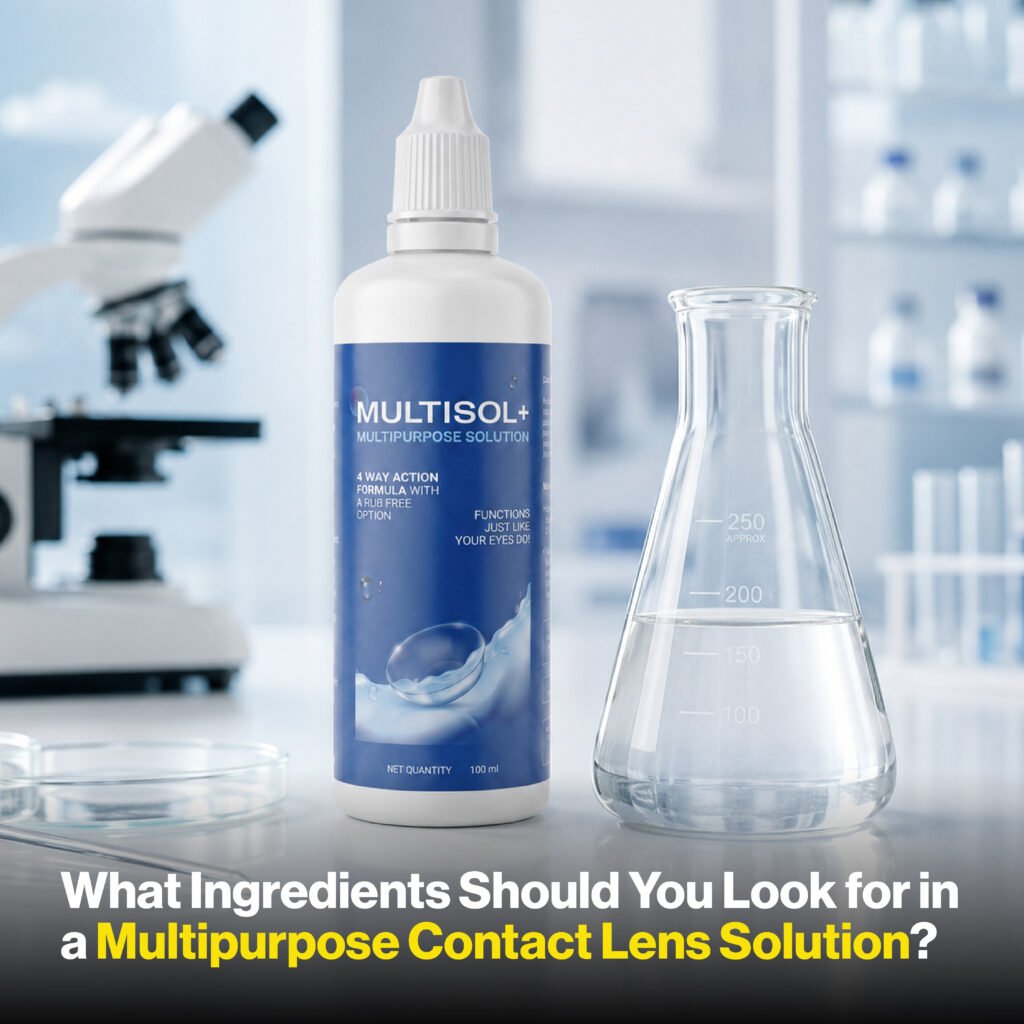
Introduction Most contact lens wearers use their solution every day without ever looking at the ingredient list on the back of the bottle. That is completely understandable. The names are long, the chemistry sounds intimidating, and the bottle is small. But knowing what is actually inside your multipurpose contact lens solution is genuinely useful. It helps you understand why your routine works, what to look for when choosing a product, and why certain ingredients matter more than others for your specific eyes and lens type. What Does a Multipurpose Contact Lens Solution Do? What ingredients are inside a multipurpose contact lens solution? Before getting into specific ingredients, it helps to understand what a multipurpose solution is actually being asked to do. Unlike a single-purpose product, it has to perform four distinct functions simultaneously. It has to clean the lens surface by breaking down and removing protein, lipid, and debris deposits. The solution disinfects by actively eliminating bacteria, fungi, and other microorganisms. It has to rinse the lens of loosened contaminants and cleaning agents before insertion. And it has to store lenses safely while maintaining their hydration and shape during the soaking period. Each of these functions is handled by a different category of ingredient. A well-formulated best multipurpose contact lens solution balances all four without any one function compromising another. Key Ingredients in Multipurpose Contact Lens Solutions The ingredient profile of a contact lens solution determines everything about its performance. Here is a breakdown of the major categories and what each one does. Ingredient Category Common Examples Primary Function Disinfecting Agents Polyhexanide (PHMB), Polyquaternium-1 Kill bacteria, fungi, and microorganisms Surfactants and Cleaners Poloxamer, Poloxamine Remove protein, lipid, and debris deposits Humectants and Conditioners Hyaluronic acid, Propylene glycol, Sorbitol Maintain lens hydration and wearing comfort Buffers and Tonicity Agents Boric acid, Sodium borate, Sodium chloride Maintain pH and osmotic balance matching natural tears Chelating Agents EDTA (Edetate disodium) Enhance disinfection by weakening bacterial cell walls Protein Removers Hydroxyalkylphosphonate Break down and remove denatured protein film Disinfecting Ingredients That Help Kill Germs What does polyhexanide do in contact lens solutions? Polyhexanide, commonly referred to as PHMB or polyhexamethylene biguanide, is one of the most widely used disinfecting agents in modern multipurpose solutions. It works by disrupting the cell membranes of bacteria and other microorganisms, effectively destroying them before they can colonise the lens surface or migrate to your cornea. PHMB is valued in contact lens solution because it provides broad-spectrum antimicrobial coverage while remaining gentle enough for regular eye contact. It targets a wide range of bacteria including Pseudomonas aeruginosa and Staphylococcus aureus, both of which are commonly implicated in contact lens eye infections. Polyquaternium-1 Polyquaternium-1, also known as Polyquad, is another commonly used disinfecting agent. It works through a similar mechanism to PHMB but has a different molecular structure that some formulations favour for its compatibility with certain lens materials. Many solutions use a combination of PHMB and Polyquad to achieve broader coverage than either ingredient alone. EDTA as a Disinfection Enhancer EDTA, or edetate disodium, does not disinfect directly but significantly enhances the effectiveness of primary disinfecting agents. It works by chelating, essentially grabbing and destabilising, metal ions in bacterial cell walls. This weakens the structural integrity of bacteria and makes them more vulnerable to the primary disinfectant. Most quality multipurpose solutions include EDTA precisely for this synergistic effect. Moisturising Ingredients for Better Comfort Which contact lens solution ingredients are best for sensitive eyes? For wearers with sensitive eyes or a tendency toward dryness, the conditioning and humectant ingredients in a solution matter just as much as its disinfecting capability. A solution that cleans perfectly but leaves your lenses feeling dry is not truly effective for your needs. 1. Hyaluronic Acid Hyaluronic acid is one of the most effective humectants available in ophthalmic formulations. It is a naturally occurring molecule in the human body that can retain up to a thousand times its own weight in water. In a contact lens solution, it binds to the lens material and helps retain moisture throughout the soaking period, so the lens you insert in the morning is genuinely hydrated rather than dry from its overnight storage. For sensitive-eye wearers, hyaluronic acid is one of the most beneficial ingredients to look for in a hydrating contact lens solution. It is well tolerated, naturally compatible with ocular tissue, and provides measurable comfort improvement during lens wear. 2. Propylene Glycol and Sorbitol Propylene glycol and sorbitol are humectant ingredients that help maintain the water content of the lens during storage and wear. They contribute to the overall comfort experience of a solution, particularly during extended wear hours when the lens is most likely to dry out. What chemical in contact solution removes protein deposits? This function belongs to the surfactant and protein-removal category. Hydroxyalkylphosphonate is a specialised ingredient found in some multipurpose solutions specifically designed to unlock and strip away denatured protein films that accumulate on the lens matrix from daily tear film exposure. Poloxamer and poloxamine surfactants handle the broader lipid and debris cleaning alongside this protein-specific action. How Do Surfactants in Lens Solution Clean Soft Contacts? How do surfactants in lens solution clean soft contacts? Surfactants work by reducing the surface tension between the lens surface and the deposits sitting on it. They have a molecular structure with one end that attracts water and another that attracts oils and organic matter. This allows them to surround and lift protein and lipid deposits off the lens surface so they can be rinsed away. When you rub your lens gently with solution before rinsing, you are activating this surfactant action mechanically. The physical rubbing combined with the chemical loosening action of the surfactant removes far more deposit than soaking in solution alone. This is why the rub and rinse method remains the recommended approach regardless of no-rub label claims. Buffering and Tonicity: The Comfort Foundation Boric Acid in Contact Solution Boric acid is a buffer, not a cleaning or disinfecting agent. It works alongside
Why Contact Lens Hygiene Matters More During Monsoon and Humid Weather?
Monsoon season brings relief from the summer heat, but for contact lens wearers across India, it also brings a set of eye care challenges that most people are genuinely unprepared for. Humidity, rainwater, increased airborne contamination, and the general wetness of the season create conditions where bacteria and fungi thrive far more aggressively than during dry months. Your regular lens care routine, which is adequate for normal conditions, may simply not be enough during monsoon. Understanding why helps you adjust before a problem develops rather than after. Why Does Humid Weather Affect Contact Lens Safety? Does high humidity affect contact lens safety and hygiene? Yes, significantly, and the mechanism is straightforward once you understand it. Bacteria and fungi need warmth and moisture to multiply. Monsoon season provides both in abundance. The ambient humidity during India’s rainy season can sit above 80 to 90 percent for weeks at a stretch. This creates an environment where microorganisms that are normally kept in check by drier conditions can multiply rapidly on surfaces, in water, and in the air itself. Your contact lens is a warm, moist surface sitting directly on your eye for 12 to 14 hours a day. In high-humidity conditions, the lens surface retains more moisture and the environment around it is richer in microbial activity. This combination creates elevated contamination risk even when your general hygiene habits have not changed. Why are eye infections more common in the rainy season for lens wearers? Monsoon air carries higher concentrations of airborne fungi, pollen, and bacteria than dry season air. Waterlogging in cities increases the presence of contaminated water in the environment. People touch their faces, eyes, and glasses more frequently when dealing with rain and humidity. All of these factors converge to make the monsoon period genuinely higher risk for contact lens wearers. Common Contact Lens Problems During Monsoon Season 1. Eye Infections and Microbial Keratitis Bacterial and fungal corneal infections spike during monsoon months in India. This is not coincidental. The same conditions that produce lush green growth across the landscape also accelerate microbial activity in the environment your eyes are constantly exposed to. Fungal keratitis in particular is a monsoon-season concern. Fungal spores are present in air and water year-round but become significantly more abundant during humid, wet conditions. A contact lens that has been exposed to contaminated rainwater or inadequately disinfected provides an entry point for these organisms. 2. Eye Irritation and Dryness Why do my eyes get sticky when wearing contacts in humid weather? This is one of the most common monsoon complaints from lens wearers. High humidity does not necessarily mean your eyes are more hydrated. It can actually disrupt the natural balance of your tear film and cause a sticky, uncomfortable feeling during lens wear. The outer lipid layer of your tear film, which controls evaporation, is sensitive to environmental changes. Humidity fluctuations, combined with increased airborne particles, can destabilise this layer and cause intermittent dryness and stickiness even when the air around you feels wet. 3. Allergic Conjunctivitis Monsoon season increases airborne pollen, mould spores, and dust mite activity. For wearers with allergies, contact lenses act as collectors for these allergens, keeping them in prolonged contact with the conjunctival surface. The result is increased itching, redness, and watering during the season. How Does Rainwater Affect Contact Lenses? Can rainy weather cause contact lens infections? Directly and genuinely, yes. Rainwater is not sterile, regardless of how clean it looks falling from the sky. By the time rain reaches you in an urban environment, it has collected atmospheric pollutants, particulate matter, and microorganisms on its way down. Contact with rainwater while wearing lenses introduces these contaminants to the lens surface and the space between the lens and your cornea. This is the same fundamental risk as tap water contact, with the added dimension of whatever urban air pollution the water has absorbed during its fall. Waterlogging and Contaminated Water Splashes Walking through waterlogged streets during heavy rain is an everyday reality in most Indian cities during monsoon. Splashes from puddles and drains can carry significantly contaminated water toward your face and eyes. For contact lens wearers, this kind of splash exposure is a meaningful infection risk. Fungi including Fusarium and Aspergillus species, which can cause serious corneal infections, are present in soil and organic matter that becomes suspended in puddle and drain water during heavy rain. A splash that lands on a contact lens can introduce these organisms directly to your corneal surface. The Right Response to Water Exposure If your lenses come into contact with rainwater or any contaminated water, remove them as soon as safely possible. Clean and disinfect thoroughly with fresh multipurpose solution before any further wear. If you experience redness, pain, or sensitivity following water exposure, remove the lenses and consult an eye care professional rather than waiting to see if symptoms resolve on their own. Essential Contact Lens Care Tips During Monsoon How to clean contact lenses properly during monsoon season? The fundamentals of lens cleaning do not change during monsoon. What changes is how consistently and carefully those fundamentals need to be applied. During high-risk seasons, shortcuts that might seem inconsequential during dry months carry genuinely elevated consequences. Rub and rinse every single time: The rub and rinse method is non-negotiable during monsoon. Place the lens in your palm, apply several drops of fresh solution, rub gently for 15 seconds on each side, then rinse thoroughly. This physical action removes the biofilm and deposits that soaking alone does not address. Use fresh solution every day without exception: Topping off old solution is inadvisable at any time of year. During monsoon, when microbial activity is elevated in the environment generally, it becomes a significantly more dangerous habit. Empty the case completely, rinse with fresh solution, and refill entirely every evening. Clean and dry your lens case thoroughly: After inserting your lenses each morning, empty the case, rinse with fresh multipurpose solution, wipe with a clean tissue, and leave open and
10 Common Contact Lens Care Mistakes That Eye Care Professionals See Every Day

Eye care professionals see the same mistakes walk through their doors every single day. Not from careless people, but from perfectly well-intentioned wearers who simply did not know that what they were doing was putting their eyes at risk. Contact lenses are safe when used correctly. The problems start when small habits, topping off solutions, sleeping in lenses, skipping a clean compound over time into something more serious. This guide covers the ten mistakes optometrists see most often, and exactly how to avoid every one of them. 1. Using Water to Clean or Store Contact Lenses What are the most common mistakes people make with contact lenses? Ask any eye care professional and water will be near the top of the list every time. Tap water, bottled water, and distilled water all look clean. None of them are sterile. Tap water in particular contains a microscopic organism called Acanthamoeba that is harmless in most contexts but devastating when trapped between a contact lens and your cornea. The resulting infection, Acanthamoeba keratitis, causes intense pain, extreme light sensitivity, and in serious cases, permanent corneal scarring that no amount of treatment can fully reverse. This rule applies to rinsing lenses, storing lenses, and rinsing the lens case. None of these should ever involve water of any kind. If you run out of solutions, the right answer is to leave your lenses out until you can purchase more, not to improvise. 2. Skipping Daily Cleaning and Disinfection How to clean contact lenses properly and why skipping even once matters? The moment a contact lens goes onto your eye, an accumulation process begins. Your tear film deposits proteins and lipids onto the lens surface. Airborne bacteria and environmental debris attach themselves throughout the day. By the time you remove your lenses in the evening, this invisible build-up is significant. Skipping your cleaning routine even occasionally allows this build-up to compound. Protein deposits that are not removed harden into a film that changes how the lens feels and how clearly it performs. Bacteria that are not eliminated by a proper contact lens cleaning solution have a warm, moist environment to multiply overnight. The rub and rinse method remains the gold standard regardless of whether your solution claims to be no-rub. Place the lens in your palm, apply fresh solution, rub gently for ten to fifteen seconds on each side, then rinse with fresh lens cleaning solution before storing. This mechanical action removes deposits that soaking alone cannot address. 3. Reusing Old Contact Lens Solution Is it bad to top off old contact lens solution in the case? It is one of the most common habits in contact lens care and one of the most genuinely risky ones. When you pour multipurpose solution into your lens case and leave your lenses to soak overnight, the disinfecting agents in that solution are doing their job. By morning, those active ingredients have been chemically depleted by the disinfecting process. The solution sitting in your case is no longer at full potency. Adding a small amount of fresh solution to this spent liquid does not restore its effectiveness. It dilutes what is already there and mixes fresh with depleted chemistry in a ratio that cannot be predicted or controlled. Bacteria that the original solution would have eliminated can survive in this weakened mixture and colonise your lens surface overnight. The correct habit is non-negotiable. Empty the case completely every morning. Rinse with fresh solution. Leave it to air dry face down. Refill with a completely fresh solution every evening. 4. Not Cleaning the Lens Case Properly How often am I supposed to replace my contact lens case? This is a question most wearers have never thought to ask, because the case looks the same from one month to the next. Replace your lens case every three months at minimum. Many eye care professionals recommend replacing it each time you open a new bottle of solution, which creates a natural and easy-to-follow schedule. A case that appears visually clean can harbour a biofilm, a thin layer of bacteria and organic matter that adheres to the case surface and resists ordinary rinsing. Between replacements, the daily maintenance routine for your case is straightforward. After inserting your lenses each morning, empty all remaining solution from the case. Rinse both compartments with fresh multipurpose solution, never tap water. Wipe with a clean tissue and leave the case open and face down to air dry completely before the next use. A contaminated case undermines every other good habit you have. Even the best contact lens solution cannot fully compensate for lenses being stored in a case that is actively breeding bacteria. 5. Sleeping With Contact Lenses Why shouldn’t I sleep with my contact lenses on? Unless your optometrist has specifically prescribed extended-wear lenses and explicitly told you they are safe for overnight use, sleeping in your lenses multiplies your infection risk significantly. During sleep, your eyelids are closed and the normal flow of oxygen and fresh tears to your cornea is already reduced. A contact lens sitting on your cornea throughout this period further restricts oxygen supply and prevents the natural tear film from flushing the lens surface. The warm, dark, low-oxygen environment created under a closed eyelid with a lens in place is close to ideal for bacterial growth. Contact lens overwear syndrome is a recognised condition that develops from consistently wearing lenses for longer than recommended, including through sleep. Symptoms include persistent redness, a gritty uncomfortable feeling, sensitivity to light, and in more serious cases, changes to the corneal surface that can make lens wear difficult long term. If you fall asleep accidentally with your lenses in, remove them as soon as you wake up, give your eyes time to breathe without lenses, and monitor for any redness or discomfort. If symptoms persist, consult your eye care professional. 6. Wearing Lenses Beyond the Recommended Time Every contact lens type has a replacement schedule that exists for a specific reason. Daily disposables
Can You Use Water Instead of Contact Lens Solution? Here’s Why You Should Never Do It

You are travelling, it is late at night, and you have just realised your contact lens solution bottle is completely empty. The bathroom tap is right there. The water looks clean. It is just one night. What is the worst that could happen? Quite a lot, actually. Some of it permanent. Using water with contact lenses is one of the most common and most dangerous habits in lens care. It does not matter whether it is tap water, bottled water, distilled water, or filtered water. None of these are safe substitutes for a proper contact lens cleaning solution. This guide explains exactly why, and what to do instead when you find yourself without solution. Why Should You Never Use Water With Contact Lenses? The Invisible Problem in Every Drop Water looks clean. Tap water in most cities is treated, filtered, and regulated. But sterile it is not. Even the cleanest tap water contains minerals, chlorine, and a range of microorganisms that are harmless when they stay in your gut or on your skin but become genuinely dangerous when introduced to your eye through a contact lens. Can I use tap water as an emergency contact solution? No, and this is worth saying as directly as possible. Tap water should never come into contact with your lenses under any circumstances, not for rinsing, not for storage, not even for rinsing the lens case. The risks are not theoretical. They are well-documented and in some cases life-altering. The most serious threat in tap water is an organism called Acanthamoeba. It is a microscopic amoeba found in tap water supplies, swimming pools, hot tubs, and even some bottled water sources. On its own, it is mostly harmless to healthy people. But when it gets trapped between a contact lens and your cornea, it finds a warm, dark, nutrient-rich environment where it burrows directly into corneal tissue. The resulting infection, Acanthamoeba keratitis, is extraordinarily painful, notoriously difficult to treat, and can cause permanent corneal scarring that affects vision for life. In severe cases, a corneal transplant is the only option for restoring partial sight. This is not a rare complication of unusually bad luck. It is a documented consequence of a habit millions of people consider harmless. Distilled and Bottled Water Are Not Safe Either Is it safe to rinse contact lenses with distilled water? Many people assume that distilled or bottled water is a safer alternative to tap water because it has been purified. It has not been sterilised. Distillation removes many contaminants but does not eliminate all microorganisms. Bottled water is regulated for drinking safety, not for direct corneal contact through a lens. Neither option is sterile in the way a purpose-built contact lens cleaning solution is sterile. Neither contains the disinfecting agents, surfactants, or pH buffering that your lenses and eyes actually need. Using either one introduces risk without providing any of the protection a proper solution delivers. What Happens If You Put Contact Lenses in Water? Can you get a parasite in your eye from washing contacts with water? Yes. This is exactly how Acanthamoeba keratitis develops, and it is one of the most serious consequences of water contact with lenses. The amoeba attaches to the lens surface, survives storage, and is then pressed directly against your cornea when you insert the lens the next morning. Beyond Acanthamoeba, here is what water does to your lenses and your eyes. Lens Swelling and Warping. Soft contact lenses are designed to maintain a specific water content and shape in a solution that closely matches the tonicity of natural tears. When lenses are placed in water, which has a different osmotic concentration, the lens material absorbs water and swells. This changes the shape of the lens, its fit on your eye, and its optical properties. A warped lens does not sit correctly on your cornea and can cause discomfort, pressure, and blurred vision. Bacterial Contamination. Tap water carries bacteria including Pseudomonas aeruginosa, a particularly aggressive pathogen that can cause rapid and severe corneal infections. Unlike a multipurpose contact lens solution, water provides no disinfecting action whatsoever. Bacteria that land on a lens stored in water are not eliminated. They are given time to multiply. Corneal Abrasion and Irritation. A warped, contaminated, or poorly fitting lens creates physical friction against the corneal surface during wear. This causes micro-abrasions, tiny scratches on the cornea that serve as entry points for infection. What begins as a slightly uncomfortable lens becomes a pathway for pathogens to access living eye tissue. What happens if you store contacts in water for one night? The lens swells and warps, losing its correct shape and fit. Bacteria from the water colonise the lens surface throughout the night with no disinfecting agent present to control them. When you insert the lens in the morning, you are placing a physically distorted, bacterially contaminated surface directly onto your cornea for hours. If you have already done this, do not insert those lenses. The steps to take are covered shortly. Why Is Contact Lens Solution Safer? What a Proper Solution Actually Does A quality contact lens cleaning solution is a precisely formulated product designed specifically for the chemistry of your eyes and your lenses. It is sterile from the moment it is manufactured and sealed. Its ingredient profile addresses every aspect of lens hygiene that water simply cannot touch. Disinfecting agents like polyaminopropyl biguanide or polyquaternium compounds actively eliminate bacteria, fungi, and other microorganisms from the lens surface. These are not just rinsed off. They are killed. Surfactants break down and remove the protein and lipid deposits your tear film leaves on the lens throughout the day. Conditioning agents like hyaluronic acid hydrate the lens material and maintain comfort. Buffering agents keep the solution at a pH matched to your natural tears, which is why a proper solution feels comfortable on your eye while water can sting. None of these functions exist in water of any kind. Water is a solvent. A contact lens
Multipurpose Contact Lens Solution vs Saline Solution: What’s the Difference?

Walk into any pharmacy and you will find an entire shelf dedicated to contact lens products. Multipurpose contact lens solutions, saline solutions, hydrogen peroxide systems, rewetting drops. It is genuinely confusing, especially when some of these products look almost identical from the outside. The most common mix-up happens between multipurpose contact lens solution and saline solution. Many wearers assume they are essentially the same thing, just different brand names for the same liquid. This assumption is not just incorrect. It can be genuinely dangerous to your eye health. Understanding what each product actually does, and more importantly what it does not do, is one of the most practical things any contact lens wearer can know. What Is Multipurpose Contact Lens Solution? A multipurpose contact lens solution is exactly what its name suggests. It is a single formula designed to handle every step of your daily lens care routine in one bottle. A quality multipurpose solution cleans, rinses, disinfects, and stores your lenses. Each of these functions relies on a different category of ingredient working simultaneously. Disinfecting agents eliminate bacteria, fungi, and other microorganisms that accumulate on the lens surface throughout the day. Surfactants loosen and lift protein and lipid deposits that your tear film leaves behind. Conditioning and wetting agents keep the lens material hydrated so your lenses feel comfortable from the moment you insert them. What makes the best multipurpose contact lens solution effective? The best multipurpose contact lens solution balances all of these functions without compromising any of them. A formula that disinfects powerfully but leaves the lens surface dry is not truly effective. Equally, a formula that conditions well but does not fully eliminate bacteria is not safe. The key ingredient categories to look for include polyaminopropyl biguanide or polyquaternium compounds as disinfecting agents, poloxamer or poloxamine as surfactants, and hyaluronic acid or propylene glycol as humectants. Together, these create a solution that addresses every aspect of lens hygiene and comfort in a single, streamlined routine. What Is Saline Solution? Saline solution is a sterile mixture of sodium chloride and purified water. In simple terms, it is salt water formulated to match the natural tonicity of human tears, which makes it gentle and non-irritating when it contacts the eye. Is contact lens solution the same thing as saline solution? No, and this distinction is critical. Saline solution does not contain any disinfecting agents, surfactants, or conditioning compounds. It is essentially a gentle rinse fluid, will not kill bacteria, will not remove protein deposits, and will not condition your lens material for comfortable wear. Sterile saline for eyes has genuine uses in contact lens care, but none of them involve replacing a proper cleaning and disinfecting routine. Saline is a rinsing aid, not a lens care system. Key Differences Between Multipurpose Solution and Saline Solution Understanding the practical difference between these two products comes down to what is actually inside the bottle. Function Multipurpose Solution Saline Solution Cleans deposits Yes No Disinfects against bacteria Yes No Rinses lenses Yes Yes Conditions and hydrates lenses Yes No Safe for lens storage overnight Yes No Suitable for sensitive eyes Depends on formula Yes, as a rinse only What is the difference between saline and multipurpose contact solution? The core difference is function. A multipurpose solution is an active lens care product containing multiple ingredient categories that each perform a specific protective role. Saline solution is a passive rinsing fluid with no active cleaning or disinfecting capability whatsoever. Think of it this way. Rinsing a wound with water removes some surface debris, but it does not disinfect or heal anything. The same principle applies here. Rinsing lenses with saline removes loose surface particles, but it does nothing to address the bacterial colonisation or protein buildup that makes proper lens hygiene essential. Can You Use Saline Solution to Clean Contact Lenses? Will saline solution disinfect my contact lenses? No. This is one of the most important things to understand about saline and one of the most common misconceptions in contact lens care. Saline solution has zero disinfecting capability. Soaking your lenses in saline overnight does not make them safe to wear the next morning. Your contact lens sits directly on your cornea, the clear living tissue at the front of your eye. Bacteria like Pseudomonas aeruginosa and Staphylococcus, as well as dangerous microorganisms like Acanthamoeba, can accumulate on lens surfaces throughout the day. If these are not actively eliminated by a proper disinfecting agent, they remain on the lens and are pressed directly against your cornea during wear. Can I use regular saline solution to store my contacts overnight? Absolutely not. This is a mistake that significantly increases your risk of developing microbial keratitis, a corneal infection that can cause permanent scarring and vision loss. Storing lenses overnight in saline provides a warm, moist environment where bacteria can multiply freely, with no disinfecting agent present to control them. Your lenses must be stored in a proper multipurpose contact lens solution or a hydrogen peroxide system overnight. These are the only two options that actually disinfect your lenses during storage. When Should You Use Each Solution? Multipurpose Contact Lens Solution: Daily Lens Care Your multipurpose solution should be your primary lens care product for daily cleaning, rinsing, disinfecting, and storing. Use it every single time you remove your lenses. Apply fresh solution to each lens, rub gently for 10 to 15 seconds on each side, rinse with fresh solution, and store in a clean case filled completely with fresh solution. Never top off old solution in your case. Disinfecting agents lose their potency after a single use cycle. Topping off creates a diluted, weakened bath where bacteria can survive and multiply. Saline Solution: Specific Supplementary Uses Can I rinse my contact lenses with normal saline? Yes, saline has a legitimate place in contact lens care as a rinsing aid in specific situations. If you need to rinse loose debris or dust off a lens before applying your multipurpose solution, sterile saline for
What Happens If You Don’t Clean Your Contact Lenses Properly?

For millions of people, contact lenses are a daily miracle. They give you crisp, clear, 360-degree vision without the weight of frames resting on your nose. But because they sit directly on your cornea—the clear, living tissue on the front of your eye—they come with a major responsibility. Your eyes naturally produce tears, proteins, and lipids (fats). While these keep your eyes healthy, they also leave behind a film on your lenses. Combined with invisible environmental debris and bacteria, your lenses can quickly turn from a vision correction tool into a breeding ground for infection if not cared for. If you have ever skimped on your cleaning routine or wondered, “What happens if I don’t clean my contact lenses with solution?“, this comprehensive guide breaks down the science of lens buildup, the hidden risks of poor hygiene, and the exact steps you need to take to protect your sight. Why Is Cleaning Contact Lenses Important? To understand why a dedicated contact lens cleaning solution is non-negotiable, you have to look at what happens to a lens over the course of a single day. The moment you place a contact lens on your eye, an microscopic accumulation process begins. The Breakdown of Lens Buildup Bacterial Colonization: Your eyes are exposed to the air, dust, and your own skin. Bacteria like Staphylococcus or Pseudomonas are incredibly common. Without daily disinfection, these microbes latch onto the porous material of your lens and multiply. Protein Deposits: Your tear film contains natural proteins that fight infection. However, these proteins denature (break down) when they bind to a synthetic contact lens. Over time, they form a foggy, jagged film over the lens surface that irritates the inner eyelid. Lipid and Biofilm Layering: Lipids (fats) from your eye’s oil glands build up alongside debris. Together with bacteria, they create a “biofilm”—a slimy protective shield that makes bacteria highly resistant to your body’s natural defense mechanisms. When you use a fresh, high-quality sterile contact lens solution, you aren’t just rinsing away visible dust. You are actively breaking down this microscopic biofilm, dissolving stubborn protein bonds, and killing pathogens before they can migrate into your eye tissue. What Are the Risks of Poor Contact Lens Hygiene? Skipping your cleaning routine or cutting corners doesn’t just cause minor discomfort; it opens the door to conditions that can permanently alter your vision. Why do my eyes hurt after wearing uncleaned contacts? When you wear uncleaned lenses, the jagged layers of denatured proteins and trapped debris rub against your cornea every time you blink. This creates micro-abrasions (tiny scratches) on the surface of your eye. Furthermore, the buildup suffocates your eye, cutting off its oxygen supply (a condition known as hypoxia). This combination of physical friction and oxygen deprivation triggers inflammatory responses, leading to redness, burning, and deep aching pain. Common Consequences of Poor Lens Hygiene Severe Eye Irritation & Chronic Dryness: Debris-laden lenses disrupt your natural tear film. This causes your tears to evaporate too quickly, leaving you with a gritty, “sand-in-the-eye” feeling that persists even after you take the lenses out. Blurry Vision & Lens Intolerance: As protein deposits build up, they alter the optical clarity of the lens, making your vision look cloudy or smeared. Eventually, your immune system may reject the dirty lens entirely, causing a condition called Giant Papillary Conjunctivitis (GPC), where bumps form under your eyelid, making it impossible to wear contacts comfortably again. Corneal Ulcers (Keratitis): If micro-scratches on your eye become infected by trapped bacteria or amoebas, an open sore called an ulcer can form on your cornea. Corneal ulcers are medical emergencies that cause intense pain, extreme light sensitivity, and can leave behind permanent scars right across your line of sight. Can You Get an Eye Infection from Dirty Contact Lenses? Yes, absolutely. In fact, poor contact lens hygiene is the single greatest risk factor for developing microbial keratitis (a corneal infection). When dangerous microbes are trapped beneath a tightly fitting lens, they are pressed directly against the vulnerable surface of the eye, giving them the perfect dark, warm, moist environment to thrive. What are the symptoms of a contact lens infection? If you experience any of the following warning signs, remove your lenses immediately and consult an eye care professional: Intense, worsening pain or aching in one or both eyes. Extreme sensitivity to light (photophobia) where you cannot open your eyes comfortably in a lit room. Unusual watery discharge, thick mucus, or yellow/green pus oozing from the eye. Severe, persistent redness that looks like “pink eye” but doesn’t improve. A sudden, noticeable drop in your visual clarity or a foggy, blurred view. The feeling that a foreign object is permanently stuck in your eye. Can dirty contact lenses cause permanent blindness? Regrettably, yes, they can. While rare, aggressive pathogens like Acanthamoeba (commonly found in tap water) or Pseudomonas aeruginosa can destroy corneal tissue with alarming speed. If an infection penetrates deep into the cornea or causes a central corneal ulcer, it leaves behind dense, opaque scar tissue. In severe, untreated cases, the infection can cause the cornea to perforate (tear open), leading to total loss of the eye or requiring emergency corneal transplant surgery to restore even partial vision. How Should You Clean and Store Contact Lenses? Preventing these devastating complications comes down to a disciplined, correct daily routine. To properly sanitize your lenses, you must use a dedicated regimen centered around an approved contact lens cleaning solution. The Step-by-Step Daily Cleaning Routine Here is the safest, clinically recommended method for cleaning and storing reusable (monthly or bi-weekly) contact lenses: Wash and Dry Your Hands Thoroughly: Always wash your hands with a mild, non-cosmetic, antibacterial soap for at least 20 seconds. Dry your hands completely with a clean, lint-free microfiber towel. Wet hands can introduce harmful tap water bacteria to your lenses. The “Rub and Rinse” Method: Place one lens in the clean, dry palm of your hand. Apply a few drops of fresh sterile contact lens solution to the lens